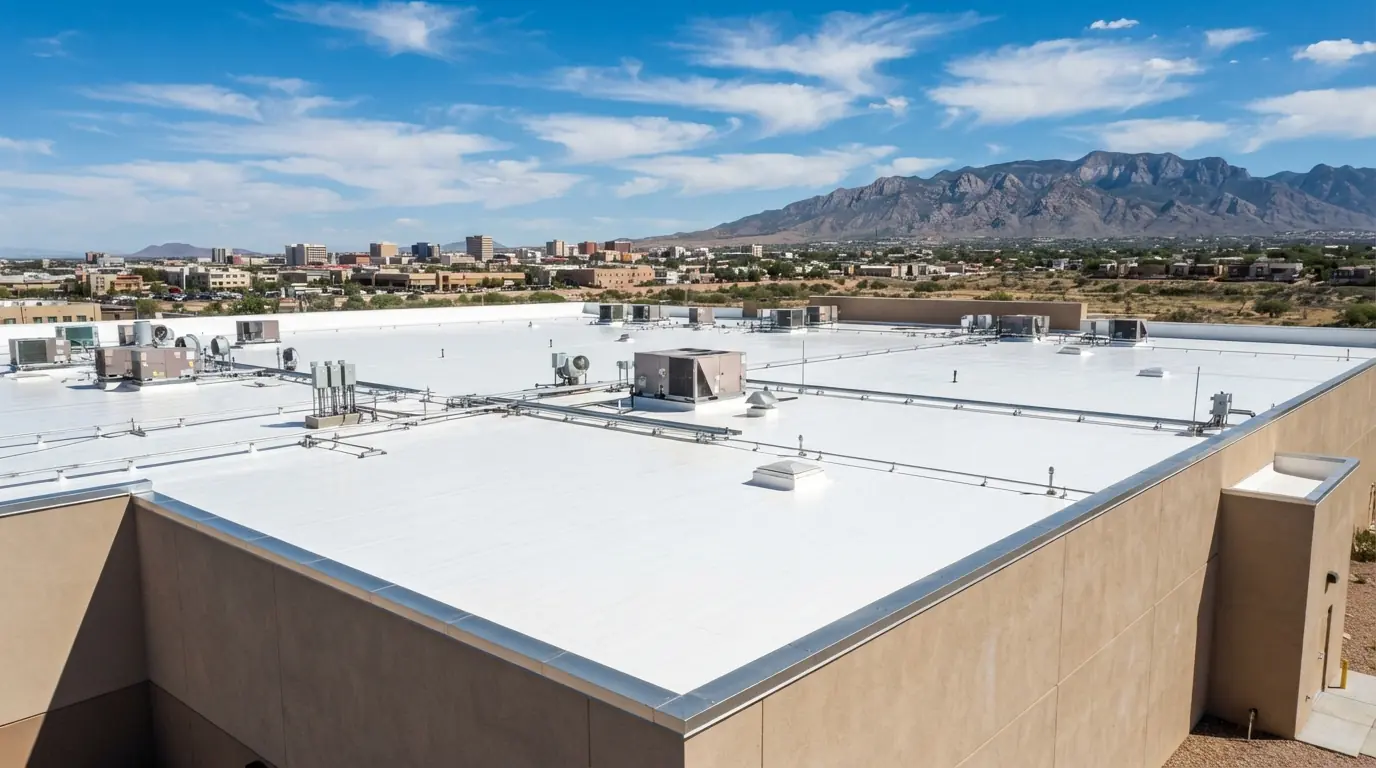
Quick answer: Commercial roof restoration in Albuquerque means cleaning and repairing an existing sound roof and applying a fluid coating system, usually silicone, over it. Published local data puts silicone coating at about $5 per sq ft at the midpoint, against $7 to $14 for installed TPO. It only works where the insulation is dry, so a moisture survey comes first.
Roof restoration
When restoration beats a re-roof
Updated September 2026
Restoration fits a roof that is weathered but sound: membrane intact, insulation dry, seams repairable. It keeps the existing roof in place, adds a new waterproof and reflective surface, and avoids the cost and noise of a tear-off over an operating building.
Where the roof is wet or failing across large areas, a full commercial re-roof is the honest answer.
Cost factors
What changes the price of this job
Planning range: TPO $7 to $14 per sq ft; silicone coating about $5 per sq ft midpoint; mandatory second-layer tear-off adds $1.50 to $3.00 per sq ft (published cost data, 2026-06). That is a planning range, not our price; the factors below move it in both directions.
- Roof area Large roofs lower the cost per square foot.
- Pre-coating repairs Seams, blisters and wet areas repaired first.
- Coating type and thickness Silicone and acrylic systems and their thickness differ in cost.
- Details Curbs, drains and parapets need reinforced detailing.
- Access Hoisting and staging on taller buildings.
Restoration pricing depends on roof area, the repairs needed before coating, and the specified coating thickness.
Your options
Restoration, repair or replacement
| Path | Best for | Disruption | Relative cost |
|---|---|---|---|
| Targeted repair | A few defined leaks on a sound roof | Low | Lowest |
| Coating restoration | Weathered but dry roof | Low | Middle |
| Full replacement | Wet insulation or failing membrane | Highest | Highest |
The work, piece by piece
Silicone Restoration Over TPO or Mod-Bit
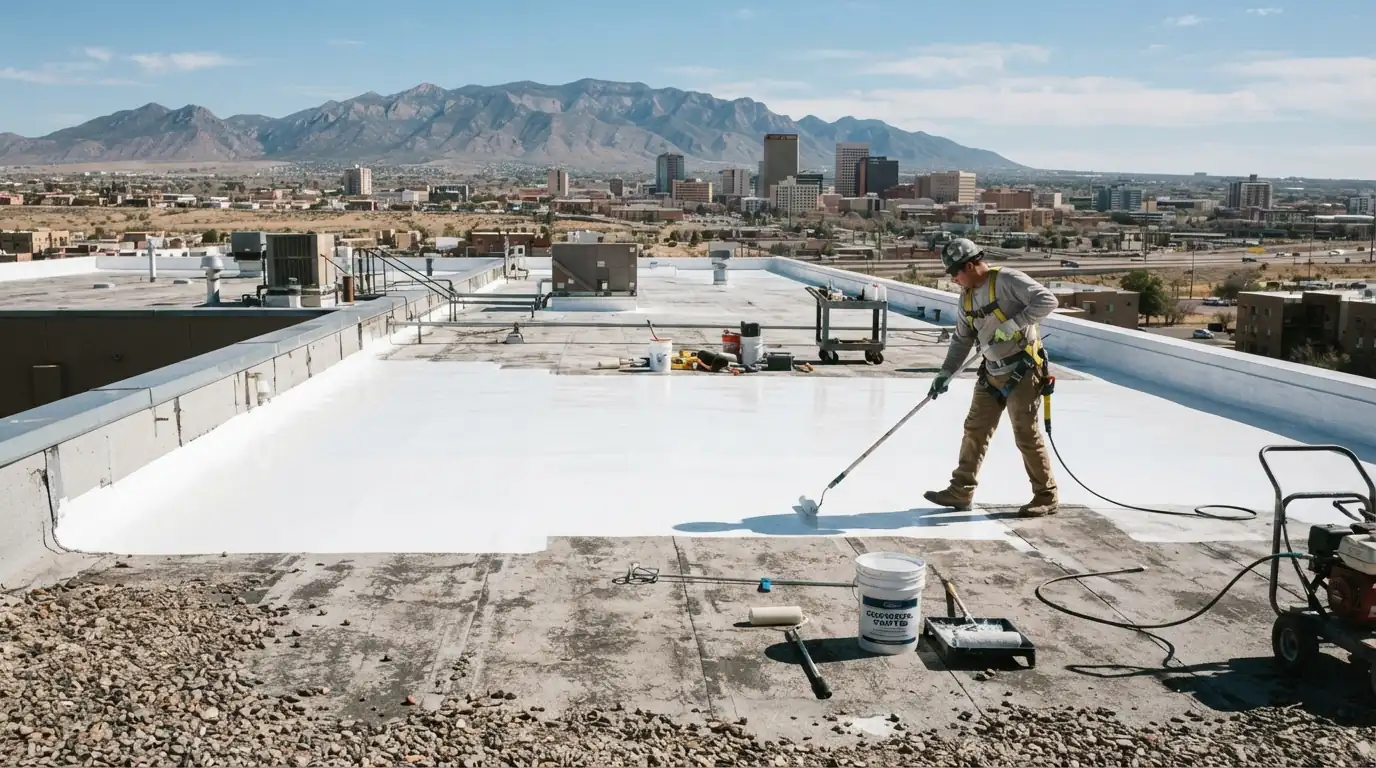
Silicone is the usual choice for low-slope commercial roofs here because it tolerates ponding and holds up to UV. The existing membrane is cleaned, primed where the substrate needs it, and repaired at every seam, blister and penetration, with fabric reinforcement at the details. The silicone then goes on at a specified thickness, measured during application. Adhesion is tested on the existing surface before the full job, because TPO and mod-bit each need their own preparation to bond reliably. The whole process is documented for the building file.
Metal Roof Coating System
On exposed-fastener metal roofs, a coating system seals thousands of screw heads and laps in one pass. Rust is treated, loose fasteners are replaced or tightened, and each fastener and seam gets a sealant or fabric detail before the full coating goes on. The result is a reflective, sealed surface that stops fastener leaks across the whole roof. It suits metal buildings whose panels are sound but whose fasteners and laps have started to fail. Gutters and trim are checked at the same time, because they fail alongside the fasteners.
Foam Roof Recoat
Spray foam roofs rely on their coating to protect the foam from UV. When the coating wears thin, a recoat restores that protection: the roof is cleaned, damaged foam is cut out and refilled, and a fresh coat goes on at full thickness. Done before the foam itself degrades, a recoat is the cheapest way to keep a foam roof in service, and it is simply the normal maintenance cycle for this system on large buildings. We log the coating thickness so the next recoat can be planned.
Moisture Survey Before Coating
A coating over wet insulation traps the moisture, keeps the deck rotting, and often voids the coating warranty. Before any restoration, the roof is surveyed for moisture with probes and core cuts in suspect areas, focusing on ponding zones, curbs and old repairs. Small wet areas are cut out and replaced before coating. If the survey finds wet insulation across a large share of the roof, we recommend replacement instead, and the survey results show why. The same survey also maps where water ponds.
Albuquerque conditions
What this job looks like on Albuquerque roofs
New Mexico jurisdictions commonly require R-25 to R-30 above-deck insulation when a low-slope roof is replaced, which is often the single largest line in a commercial re-roof budget. A restoration keeps the existing roof and its insulation in place, which is a large part of why it costs so much less. The trade-off is that the building keeps the insulation it has today, so owners who want better energy performance may still prefer a full replacement when the time comes.
How the job runs
How a restoration project runs
- 1
Moisture survey
Probes and cores in ponding zones, curbs and old repairs.
- 2
Scope and option pricing
Restoration and replacement priced side by side.
- 3
Clean and repair
Roof washed; seams, blisters and wet areas repaired.
- 4
Detail the roof
Fabric and base coat at seams, curbs and drains.
- 5
Apply the coating
Specified thickness, measured during application.
- 6
Close-out
Thickness records, photos and a recoat schedule.
FAQ
Commercial roof restoration questions
It depends on the system and the thickness applied; the scope states both and when to recoat.
Yes. There is no tear-off, so noise and disruption are far lower than a re-roof.
Silicone tolerates ponding, but severe ponding is better corrected first.
Only a sound one with dry insulation. The moisture survey decides.
Silicone for low-slope roofs that hold water; acrylic where drainage is good.
Systems from GACO, Everest Systems, Tremco and Karnak, chosen by roof type.