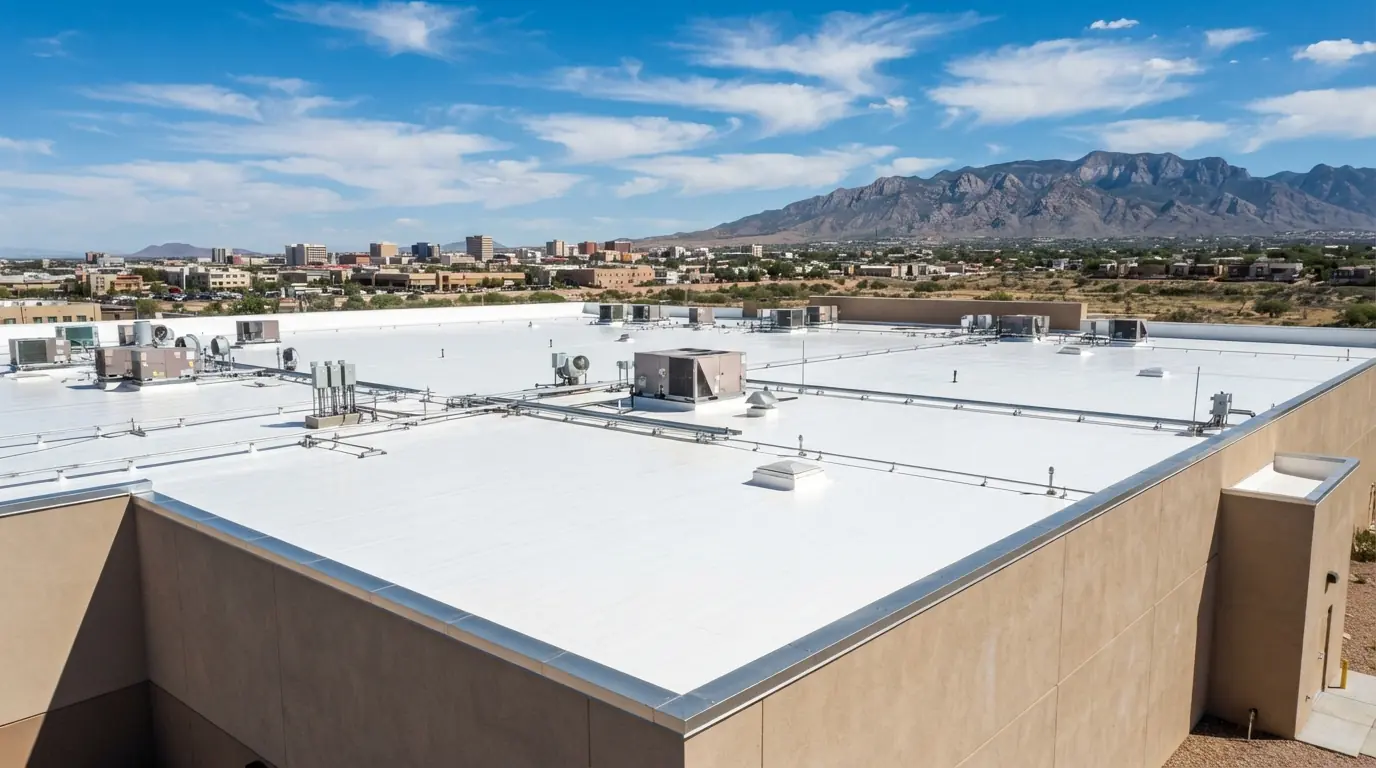
Quick answer: Commercial roof replacement in New Mexico runs from about $4 per sq ft for a ballasted TPO overlay with no added insulation to about $15 per sq ft for a multi-ply modified bitumen system with R-25 to R-30 insulation, according to 2026 cost data. The insulation requirement, existing layers and access drive most of that difference.
Commercial re-roofing
Replacement versus one more round of repairs
Updated September 2026
When repair tickets keep coming, the insulation is wet across large areas, or the membrane is past its service life, replacement costs less over the hold period than patching. When the roof is dry and sound, a coating restoration may buy years instead.
We lay out both paths with the numbers, and if the roof still has life, we say so and quote commercial roof repair instead.
Cost factors
What changes the price of this job
Planning range: $4 per sq ft for ballasted TPO overlay with no insulation to $15 per sq ft for multi-ply mod-bit with R-25 to R-30 insulation (published cost data, 2026-01). That is a planning range, not our price; the factors below move it in both directions.
- Insulation requirement Reaching the required R-value is often the largest line.
- Existing layers A second layer forces full tear-off under the building code.
- System choice TPO, mod-bit and built-up differ in cost and weight.
- Access and lifts Cranes, hoists and street closures on taller buildings.
- Phasing More phases and after-hours work add mobilization cost.
Albuquerque-specific data puts installed TPO at $7 to $14 per sq ft, with a mandatory second-layer tear-off adding $1.50 to $3.00 per sq ft.
Your options
Commercial replacement options side by side
| Option | TPO re-roof | Multi-ply mod-bit | Coating restoration |
|---|---|---|---|
| When it fits | Most low-slope buildings | Heavy traffic, lots of equipment | Dry, sound existing roof |
| Insulation | Brought to code | Brought to code | Unchanged |
| Weight | Light | Heavier | Lightest |
| Relative cost | Middle | Higher | Lowest |
The work, piece by piece
TPO Commercial Re-Roofs
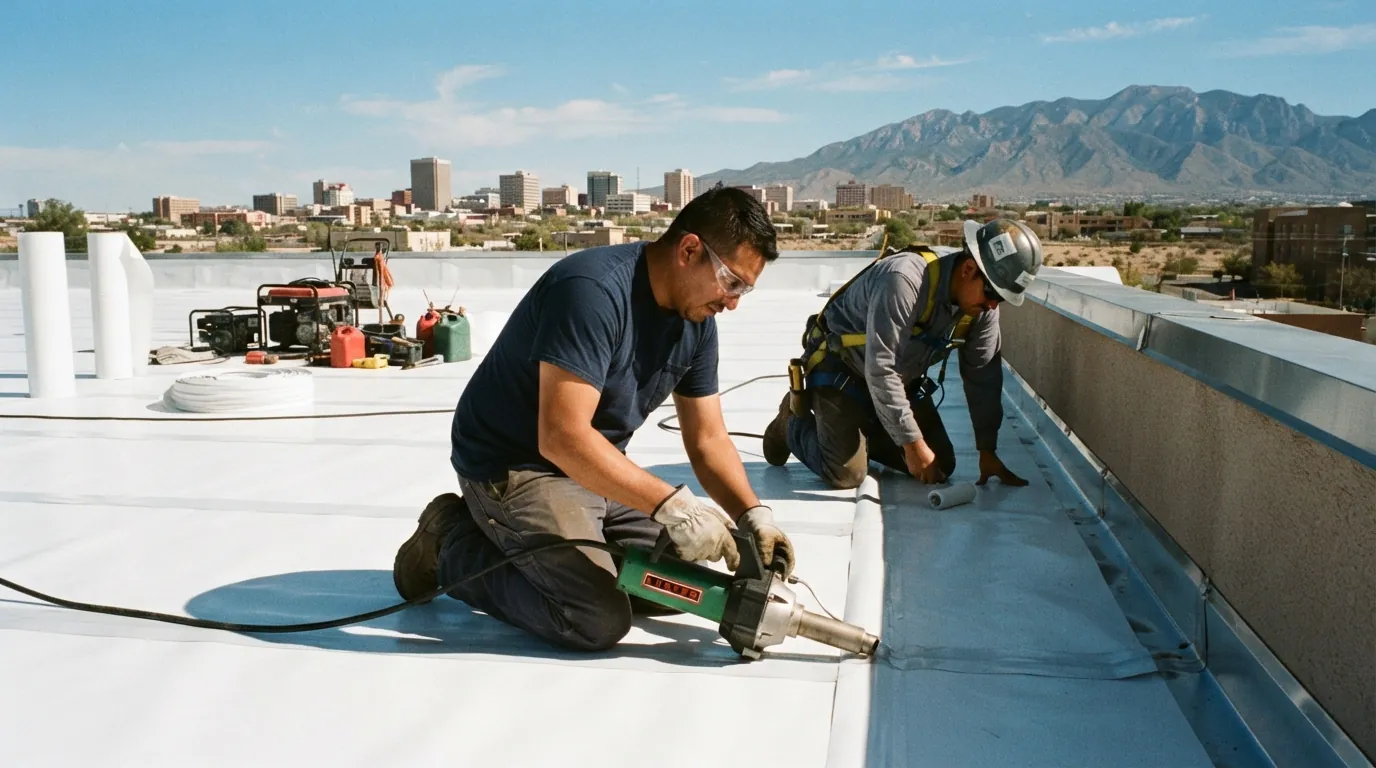
TPO is the most common commercial replacement system here: a white, heat-welded single-ply membrane that reflects much of the sun and keeps rooftop temperatures down. It goes over new insulation, either mechanically attached or fully adhered, with welded seams and flashing at every curb and parapet. We specify the membrane thickness to the building's traffic and expected hold period, and add walkway pads along mechanical service routes so service technicians do not slowly wear through the roof they are standing on.
Modified Bitumen and Built-Up Re-Roofs
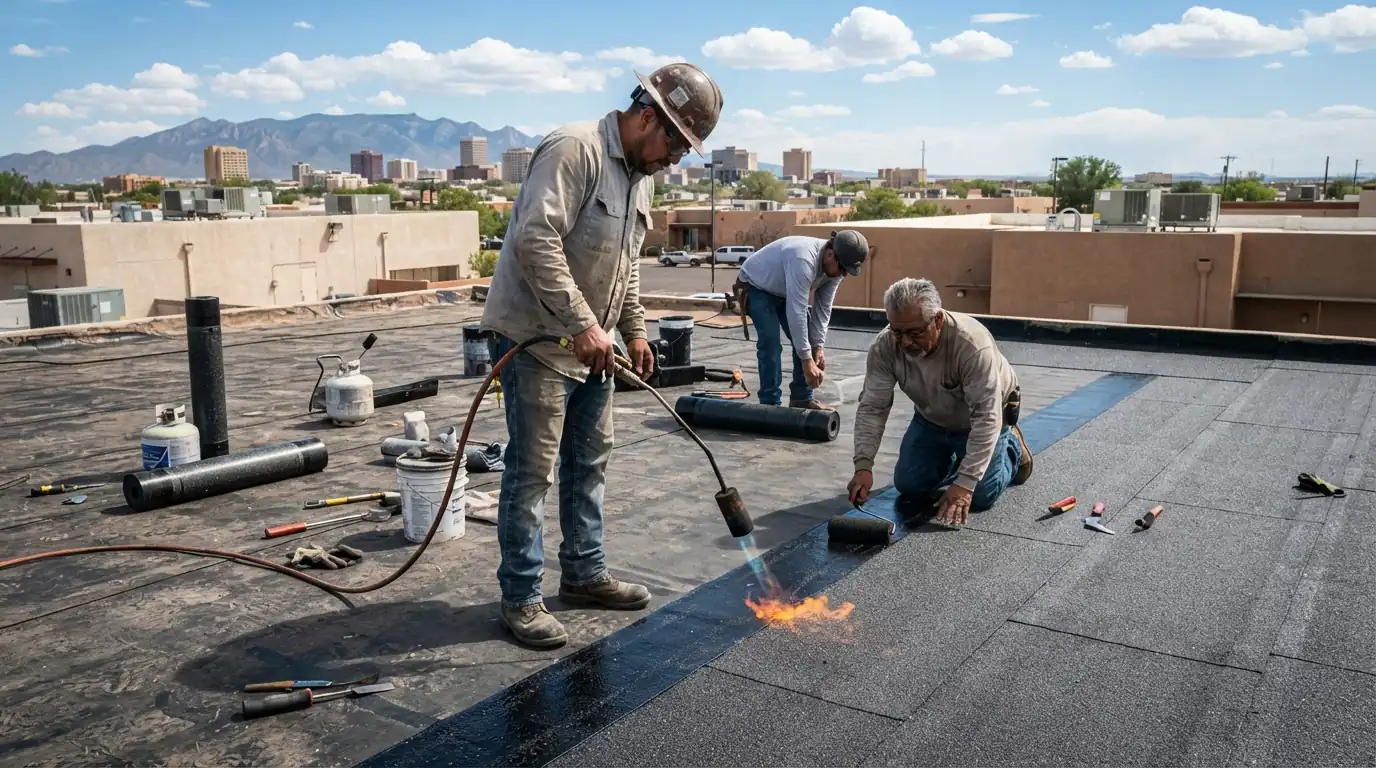
Multi-ply systems still make sense on roofs with heavy foot traffic, lots of equipment, or owners who want redundancy. A two- or three-ply modified bitumen system, or a traditional built-up roof, gives several layers of protection rather than one. They are heavier and usually cost more per square foot, and they need a reflective cap or coating to handle the sun here. We price them alongside TPO when the building's use points that way, so the owner can compare the trade-offs directly.
Insulation and R-Value Upgrades
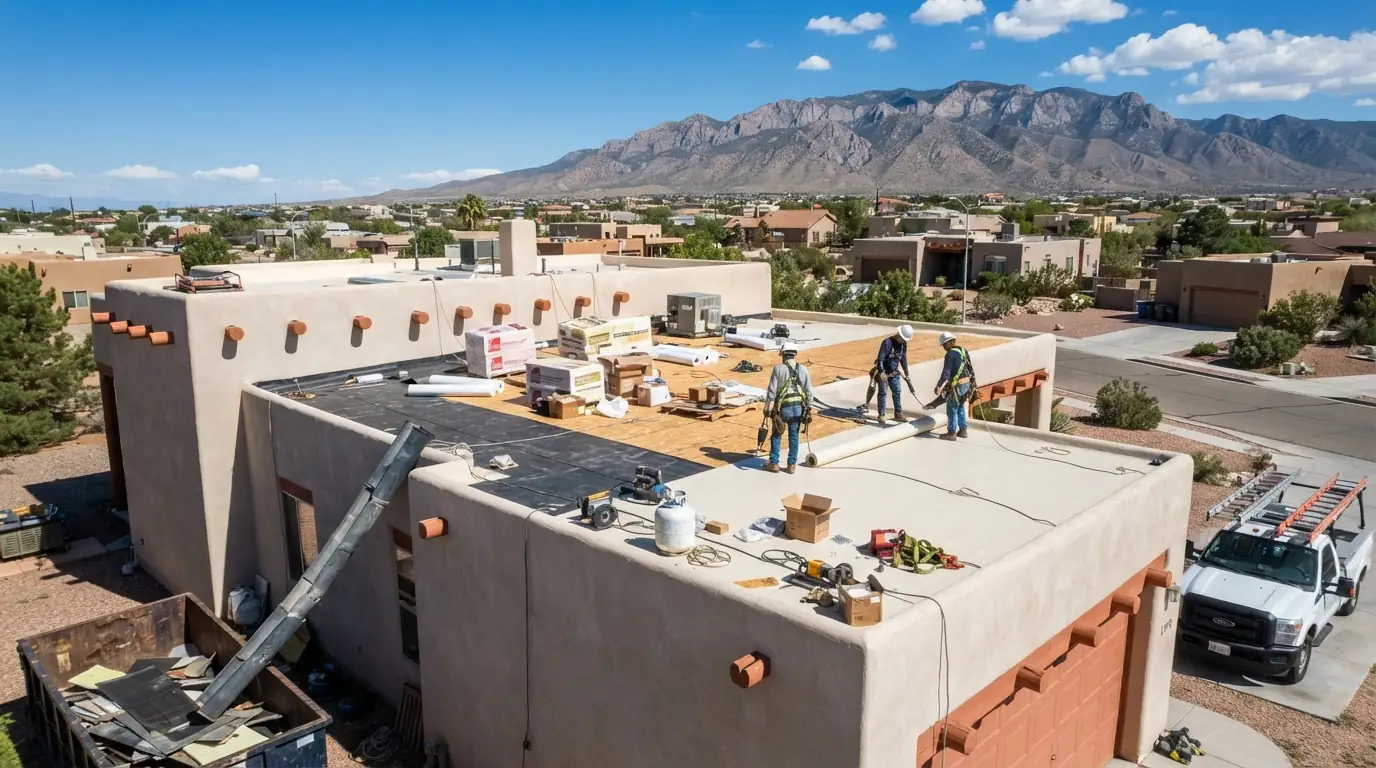
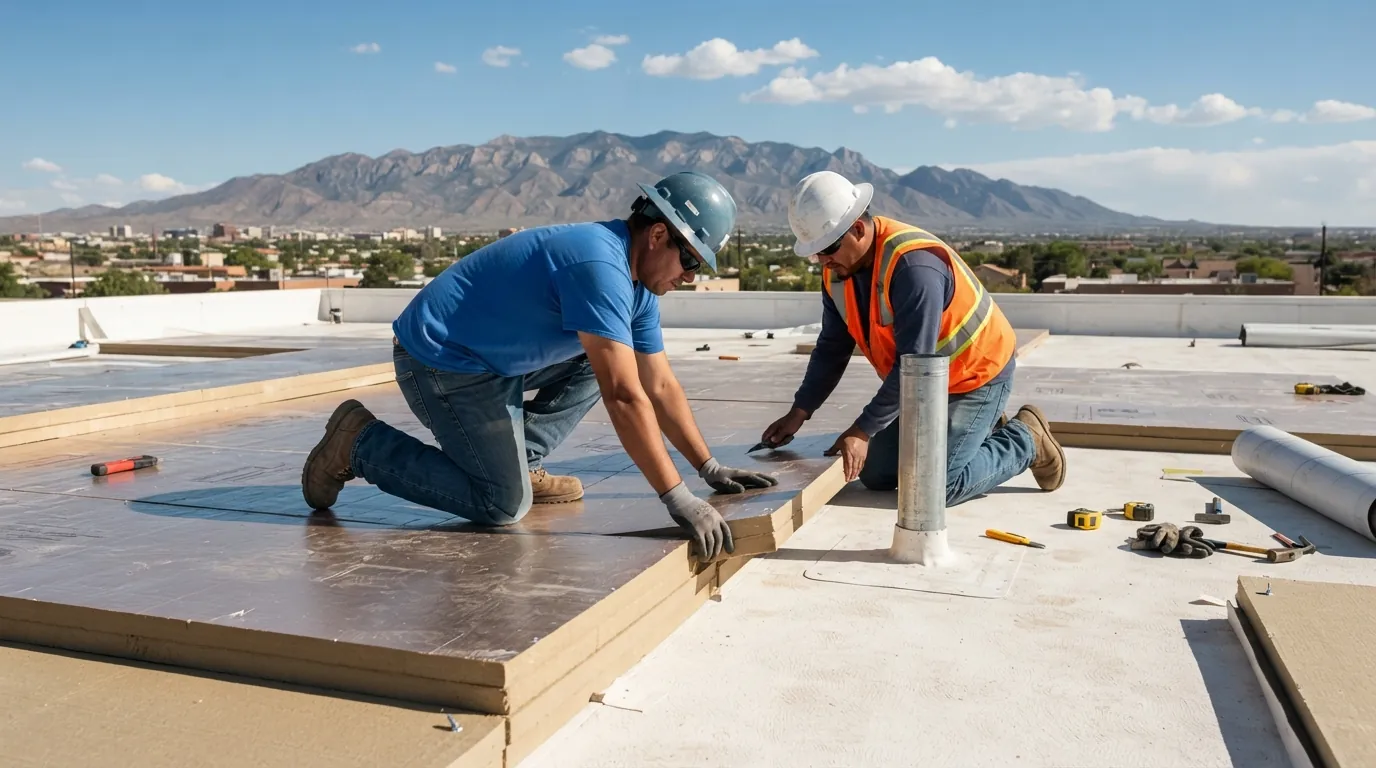
A re-roof is the moment the insulation gets brought up to current requirements, and that is often the biggest line in the budget. Wet board comes out, new polyiso or cover board goes down to the required R-value, and tapered insulation is added where the roof ponds. The energy savings over the building's life are real, and on a building with standing water problems, the tapered layout often matters more than the membrane choice. The scope shows the insulation plan, not just the membrane.
Phased Re-Roofs for Occupied Buildings
Most commercial roofs are replaced over working buildings. We break the roof into sections, open only what can be closed the same day, and schedule noisy tear-off and crane lifts around tenant hours where the building needs it. Rooftop units are coordinated with the mechanical contractor, and interior protection goes in under active work areas. Tenants and the property manager get a schedule before work starts and an update whenever weather changes it, so nobody is surprised by the crew overhead.
Albuquerque conditions
What this job looks like on Albuquerque roofs
Two rules drive commercial re-roof budgets in this market. New Mexico jurisdictions commonly require R-25 to R-30 above-deck insulation when a low-slope roof is replaced, which is why insulation often costs more than the membrane on top of it. And under IBC Section 1511.3, once two roof layers exist, both must come off. Many mid-century commercial buildings in Albuquerque already carry a second layer from an earlier re-cover, so we core the roof before quoting to know which case applies.
How the job runs
How a commercial re-roof is planned and built
- 1
Survey and core
Layer count, moisture checks and drainage mapped.
- 2
Options and budget
Replacement and restoration paths priced side by side.
- 3
Permit and schedule
Permit filed and phases agreed with the manager.
- 4
Tear off by section
Only what can be closed the same day is opened.
- 5
Insulate and install
Tapered and flat insulation, then the membrane system.
- 6
Close-out package
Photos, inspection sign-off and as-built notes.
FAQ
Commercial re-roof questions
Yes, in most cases. We phase the work and schedule the loudest tasks around business hours.
If the roof is dry and sound, often yes. We price it next to replacement so you can compare.
We coordinate with your mechanical contractor to lift, disconnect or work around them.
A full re-roof generally triggers current insulation requirements, which we build into the scope.
Yes. Roofs can be split into sections and replaced over more than one budget year.
Carlisle SynTec, GAF, Firestone and Johns Manville systems, among others. The scope names the system.