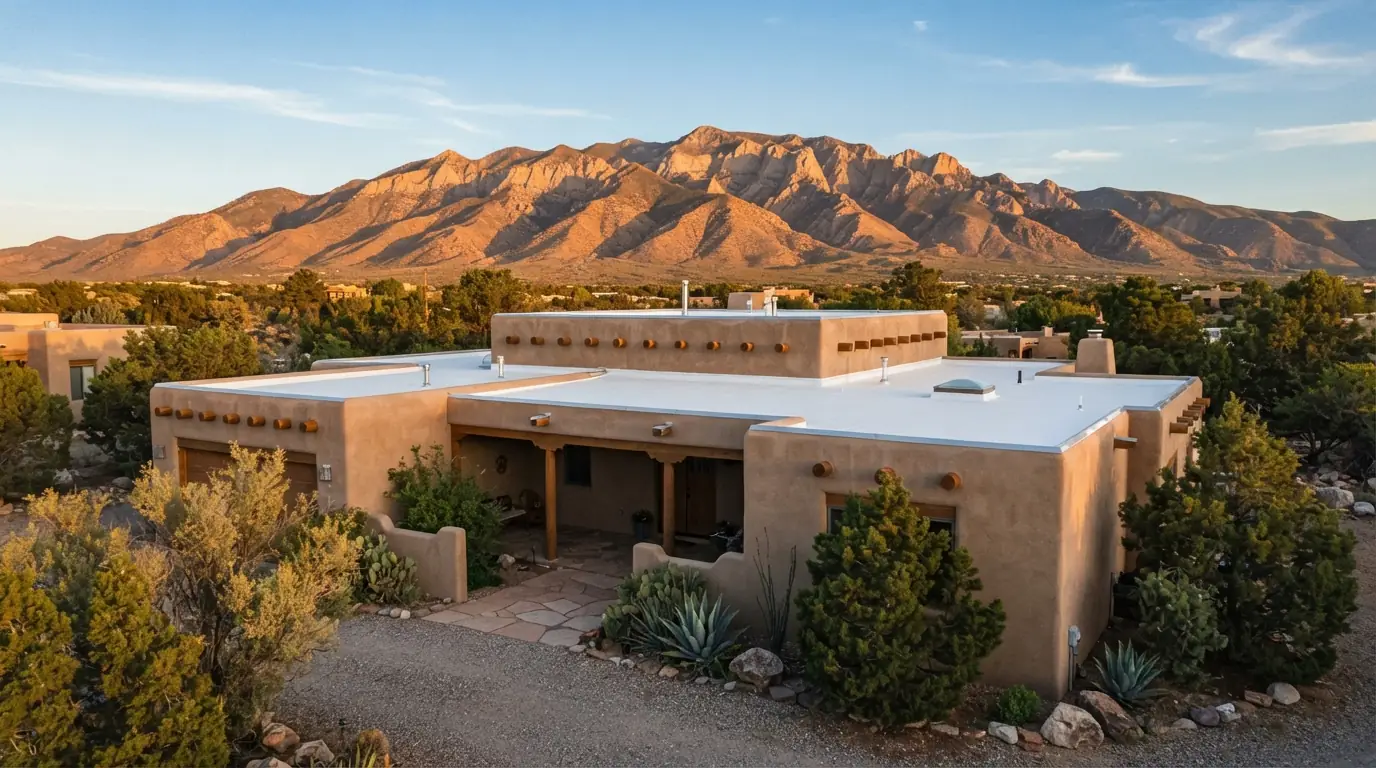
Quick answer: Replacing a flat roof in Albuquerque means tearing off to the deck, removing any wet insulation, and correcting drainage before a new system goes on. Where two or more layers already exist, the building code requires full tear-off. The new roof is then TPO, modified bitumen or spray foam, chosen by deck, drainage and how the roof gets used.
Tear-off and rebuild
When a flat roof is past repairing
Updated September 2026
A flat roof is done when the problem is no longer in one place. Blisters across the field, several leaks at once, insulation that gives underfoot, or felt showing through the gravel are system failures, and a patch only moves the leak. Flat roof repair still makes sense when the damage is contained.
A replacement is also the one chance to fix what the old roof got wrong, usually drainage. Most of the value sits below the new membrane.
Cost factors
What changes the price of this job
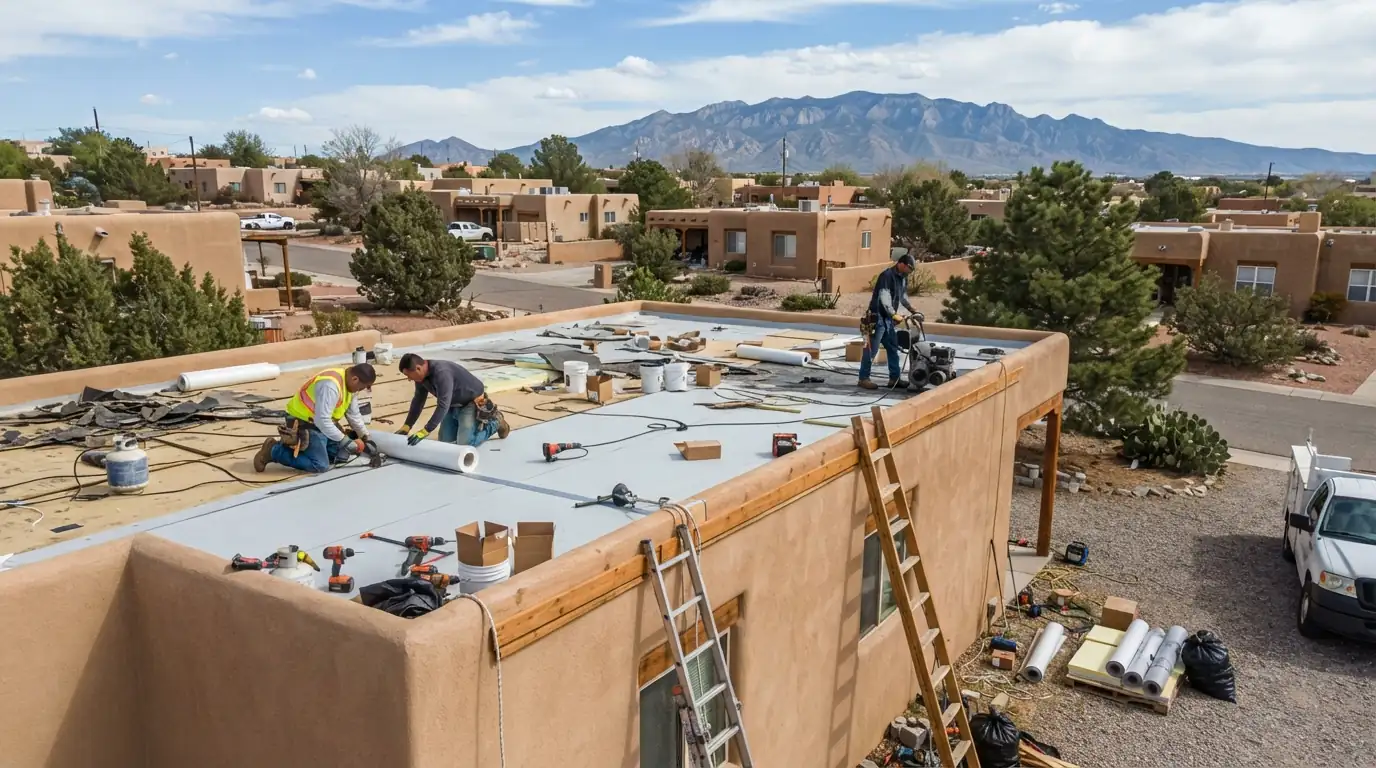
Planning range: $5.50 to $9.00 per sq ft installed; roughly $8,250 to $13,500 for a 1,500 sq ft flat roof (published cost data, 2026-05). That is a planning range, not our price; the factors below move it in both directions.
- Layers to remove Tar and gravel and multi-layer roofs take longer to strip and cost more to haul.
- Wet insulation Every wet board found during tear-off is cut out and replaced.
- Deck repairs Soft or rotted decking is replaced by the sheet.
- Drainage correction Tapered board and crickets add material where the roof ponds.
- System and grade TPO, mod-bit and foam price differently, and so do their grades.
National figures price removal of the old roof at $1 to $5 per sq ft.
Your options
How the replacement systems compare over the years
| What matters | TPO | Modified bitumen | Spray foam |
|---|---|---|---|
| Summer surface temperature | Low; white and reflective | High unless given a reflective cap | Low under a white topcoat |
| Upkeep | Seam and flashing checks | Seam and flashing checks | Periodic recoating |
| Walkable for service | With walkway pads | Yes | Lightly |
| Albuquerque planning range | $4.00 to $6.00 per sq ft | $3.50 to $5 per sq ft | Priced per roof |
The work, piece by piece
Tar and Gravel Tear-Off
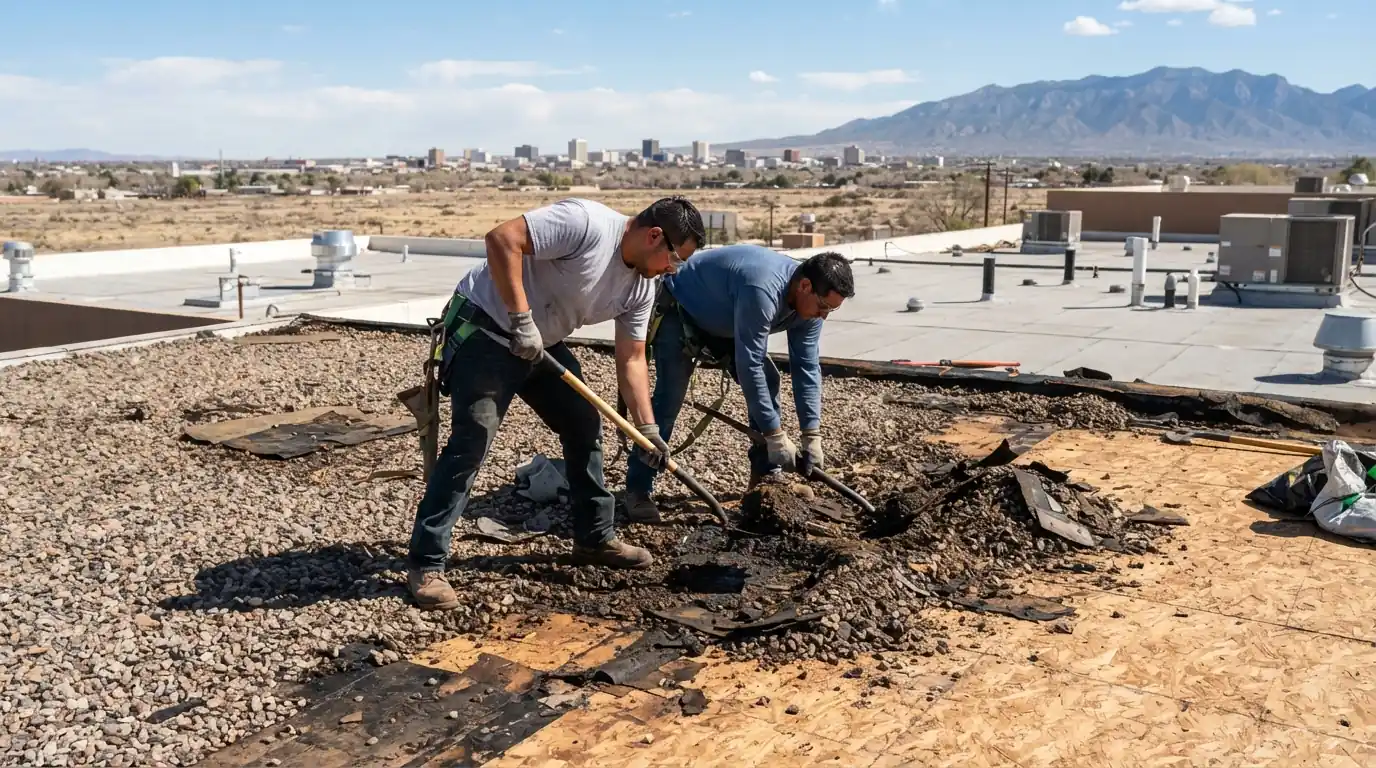
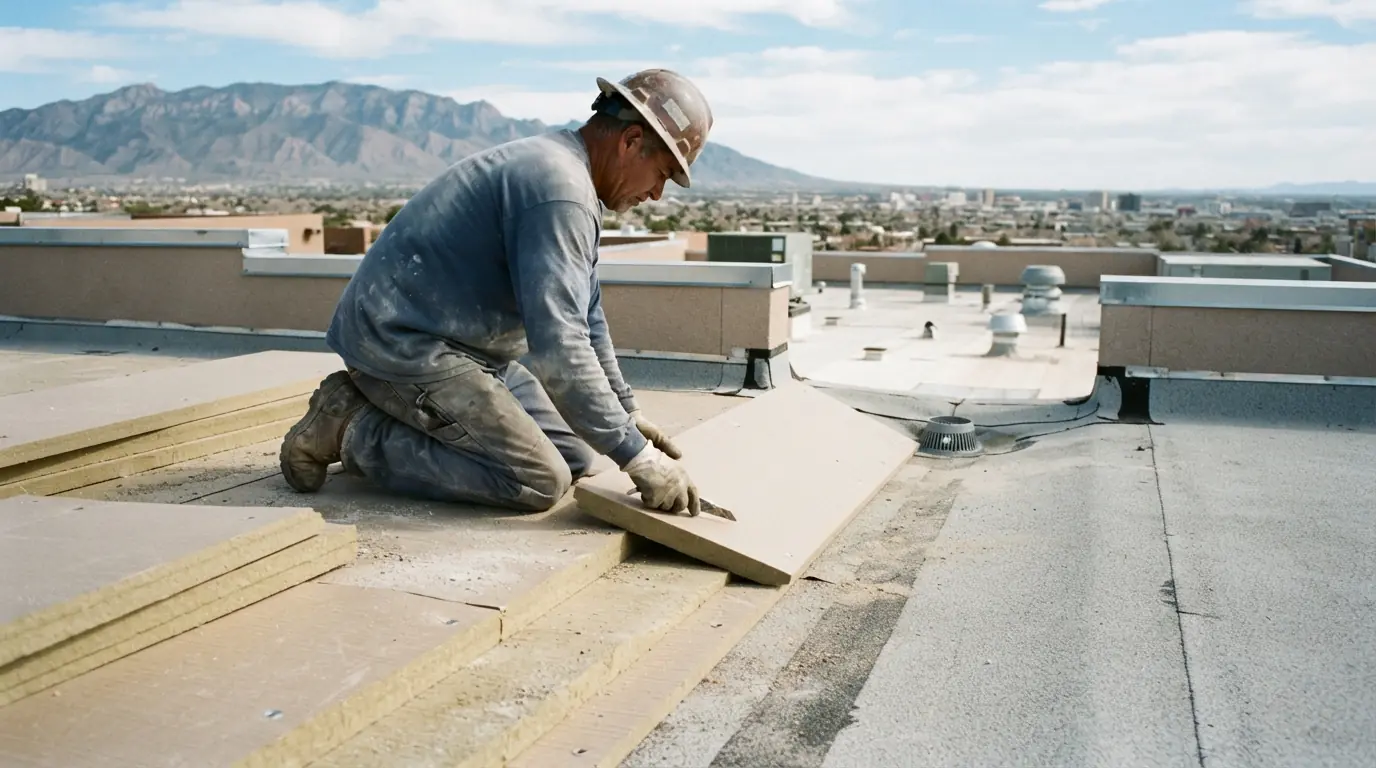
Tar and gravel is heavy, messy and often more than one layer deep, so the tear-off is a real part of the job. We scrape the gravel, cut the built-up felt into manageable sections, and lower it to a dump trailer rather than throwing it past windows. Under it there is often old flashing buried at the parapets and canales, and that comes out too. The deck is then swept and checked board by board, and any soft section is replaced before insulation goes back.
Wet Insulation Removal
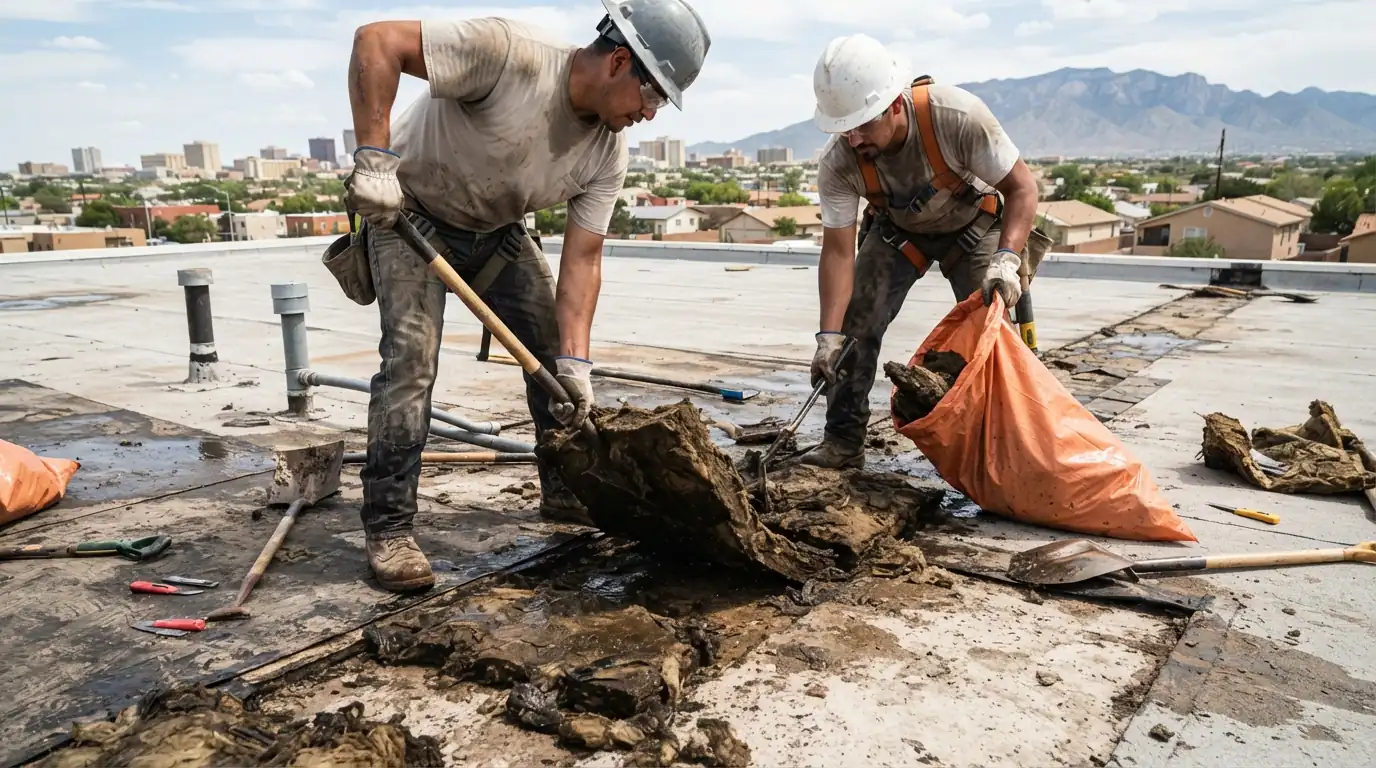
Water that gets past an old membrane usually soaks the insulation long before it shows on a ceiling. Wet board loses its insulating value, holds moisture against the deck and, if it is covered over, keeps rotting the wood under a brand new roof. We probe and core suspect areas during tear-off, cut out everything wet back to dry material, and replace it. If the deck under it has softened, that section is replaced too. It is the least visible line on the invoice and one of the most important.
Tapered Insulation for Drainage
Many older flat roofs were built dead level, so water sits for days after a storm. Tapered insulation fixes that with factory-cut boards that build a gentle slope toward the canales, scuppers or drains. We draw the taper plan from measurements taken before tear-off, add crickets behind curbs and chimneys where water gets trapped, and check the finished slope with a level before the membrane goes down. On a roof with chronic ponding, this line decides how long the new roof lasts.
Choosing TPO, Mod-Bit or Spray Foam
The system comes last, after deck and drainage are sorted. TPO is the most common choice for homes here: white, welded and reflective. Modified bitumen holds up best where rooftop equipment gets serviced often. Spray foam suits roofs crowded with penetrations and adds insulation, but it needs periodic recoating. The comparison on this page lays out the trade-offs, and your scope prices the options that fit. If you already have a system in mind, tell us on the call and we will price that one first.
Albuquerque conditions
What this job looks like on Albuquerque roofs
Tar and gravel has long been the most common covering on New Mexico flat roofs, so many replacements in Albuquerque start with a heavy tear-off. The City requires a re-roof permit when a contractor does the work, calls for an inspection once the job is about half complete, and may ask for a core sample to count existing layers. We schedule the tear-off so that inspection lands at the right stage, and we core the roof ourselves beforehand so the layer count is never a surprise on day one.
How the job runs
From tear-off to a dry, sloped roof
- 1
Measure, core and plan
Layers counted, ponding mapped, taper plan drawn before anything comes off.
- 2
File the permit
The City re-roof permit is filed before tear-off day.
- 3
Tear off in sections
Only what can be closed the same day is opened.
- 4
Repair deck and insulation
Wet board and soft decking come out; new material goes in.
- 5
Install the system
Tapered board, then membrane or foam, flashed into every edge and curb.
- 6
Inspect and hand over
Permit inspection, a final walk and photos of the finished roof.
FAQ
Flat roof replacement questions from Albuquerque homeowners
Several leaks at once, widespread blisters, soft spots or felt showing through the gravel. One leak at a canale usually does not.
Sometimes, over one dry layer. If the roof already has two layers or the insulation is wet, code and common sense both say tear it off.
Only what can be closed the same day is opened, and tarps stay on site.
It is lifted, the curb is rebuilt or reflashed into the new roof, and the unit goes back.
For a contractor re-roof in the City of Albuquerque, yes. We file it and schedule the inspection.
The written scope gives you the day count before anything is booked.