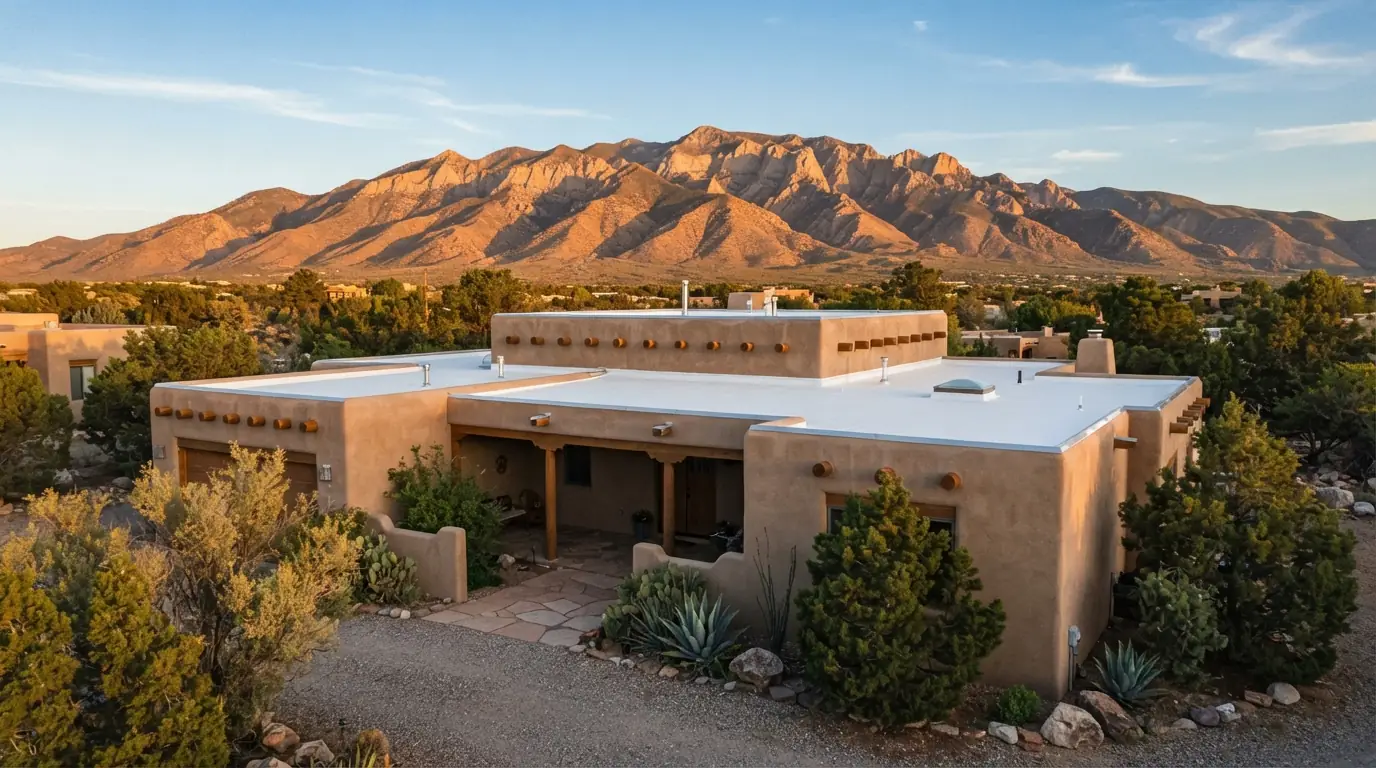
Quick answer: Modified bitumen roofing in Albuquerque is a multi-ply flat roof system, installed by torch or as self-adhered sheets, with a granulated or coated cap on top. Published local data puts modified bitumen at $3.50 to $5 per sq ft and torch-down at $7 to $9. It handles foot traffic better than most single-ply roofs.
Asphalt membrane systems
Where mod-bit beats a white single-ply roof
Updated September 2026
Mod-bit's strength is toughness. Two or three plies of reinforced membrane shrug off foot traffic around swamp coolers and rooftop units, resist hail punctures, and can be patched with the same material for decades.
Its weakness here is heat. A dark granulated surface runs much hotter than white TPO, so we often finish it with a white granule cap or a reflective coating.
Cost factors
What changes the price of this job
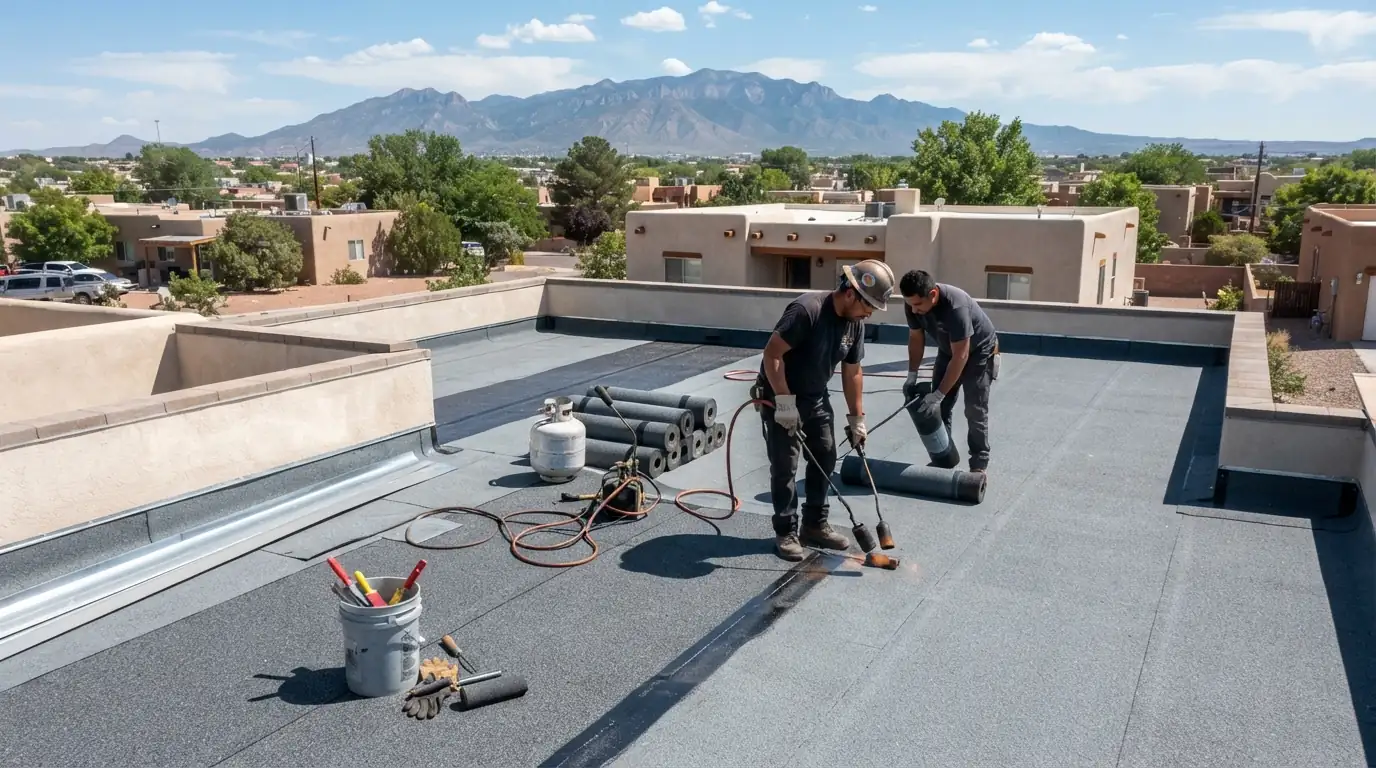
Planning range: modified bitumen $3.50 to $5 per sq ft; torch-down $7 to $9 per sq ft (published cost data, 2026-05). That is a planning range, not our price; the factors below move it in both directions.
- System plies Three-ply costs more than two-ply for the extra sheet and labor.
- Torch or self-adhered Self-adhered sheets cost more per roll but save time near wood.
- Cap surface White granule caps and reflective coatings add to a plain cap.
- Tear-off Removing old layers and wet insulation adds labor and disposal.
- Details Parapets, canales and every curb need their own flashing work.
Your options
Torch-down, self-adhered and cold-applied mod-bit
| Method | Torch-down | Self-adhered | Cold-applied |
|---|---|---|---|
| How it bonds | Heated asphalt fuses the sheet | Factory adhesive layer | Adhesive spread on the roof |
| Open flame | Yes | No | No |
| Best use | Open field of the roof | Near wood, curbs and eaves | Small or complex areas |
| Weather needs | Dry | Dry and warm | Dry, longer cure |
The work, piece by piece
Torch-Down Installation
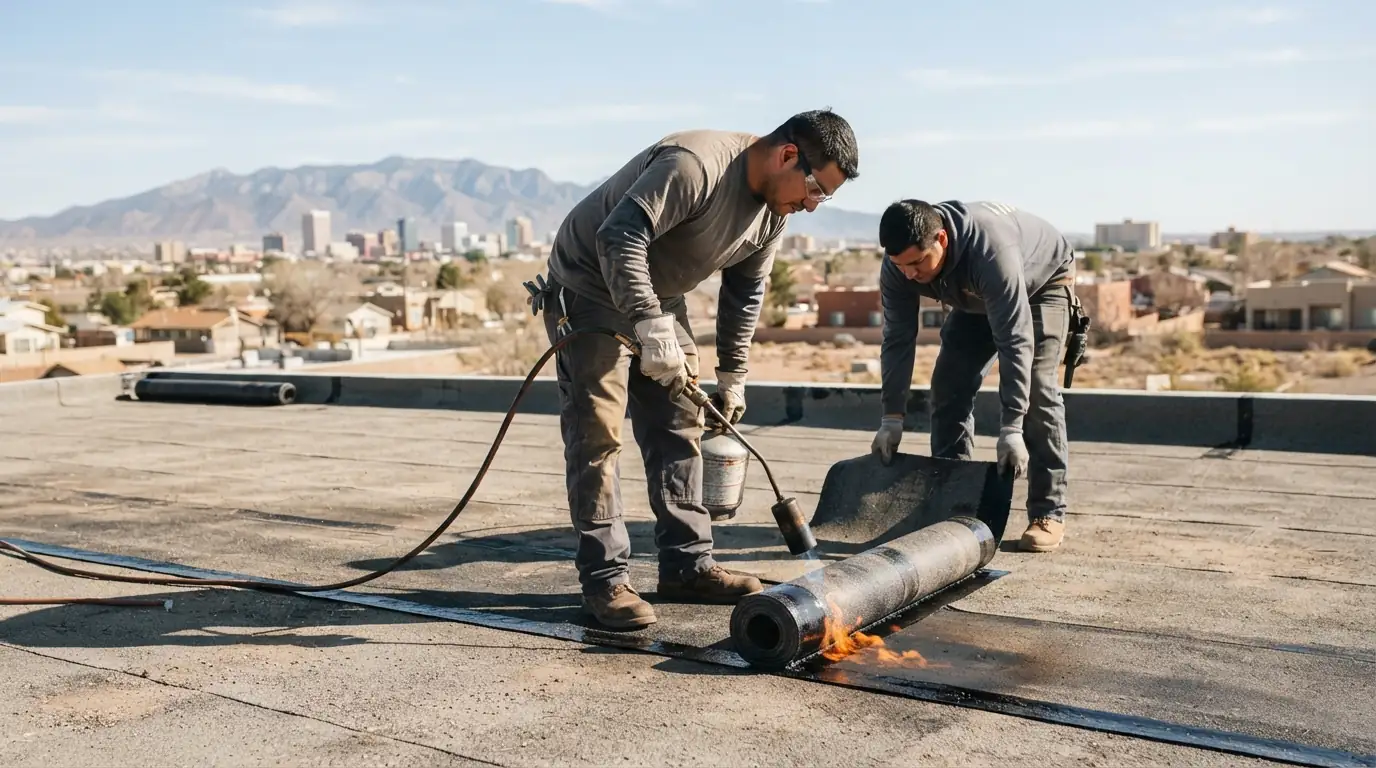
Torch-down sheets are heated with a propane torch until the asphalt on the underside melts and fuses to the layer below. Done well, it makes a strong, fully bonded roof with laps that are fused rather than glued. It also means an open flame on a roof, so we follow strict fire precautions: no torching directly against wood or near vents and eaves, a fire watch after the last sheet, and self-adhered sheets in the risky spots instead of a flame.
Self-Adhered Modified Bitumen
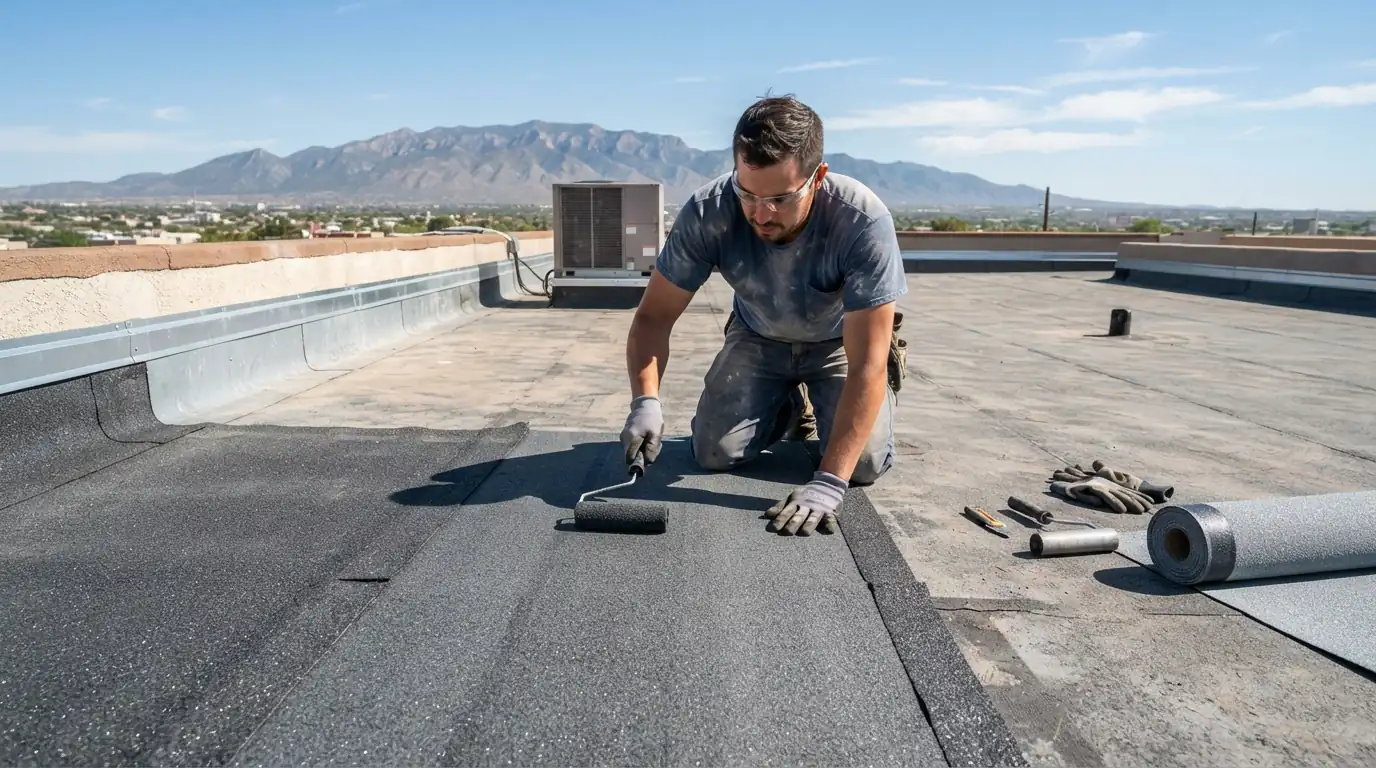
Self-adhered sheets come with a factory adhesive layer under a release film, so they go down without a torch. That makes them the safer choice around wood parapets, skylight curbs and eaves, and on homes where an open flame is simply not worth the risk. They need a clean, dry, warm surface and firm rolling to bond fully, which suits the Albuquerque climate most of the year. Many of our mod-bit roofs combine both: self-adhered base and details, torched cap in the open field.
Two-Ply or Three-Ply Systems
A two-ply system is a base sheet plus a cap sheet, and it is the standard for most residential flat roofs. A three-ply system adds an interply sheet between them, which gives more thickness and more redundancy: a cut or puncture in the cap still has two layers beneath it. We recommend three-ply on roofs with heavy equipment traffic or commercial use, and two-ply for most homes. Both prices go in the scope, side by side, so the choice stays with you.
Mod-Bit Seam and Blister Repair
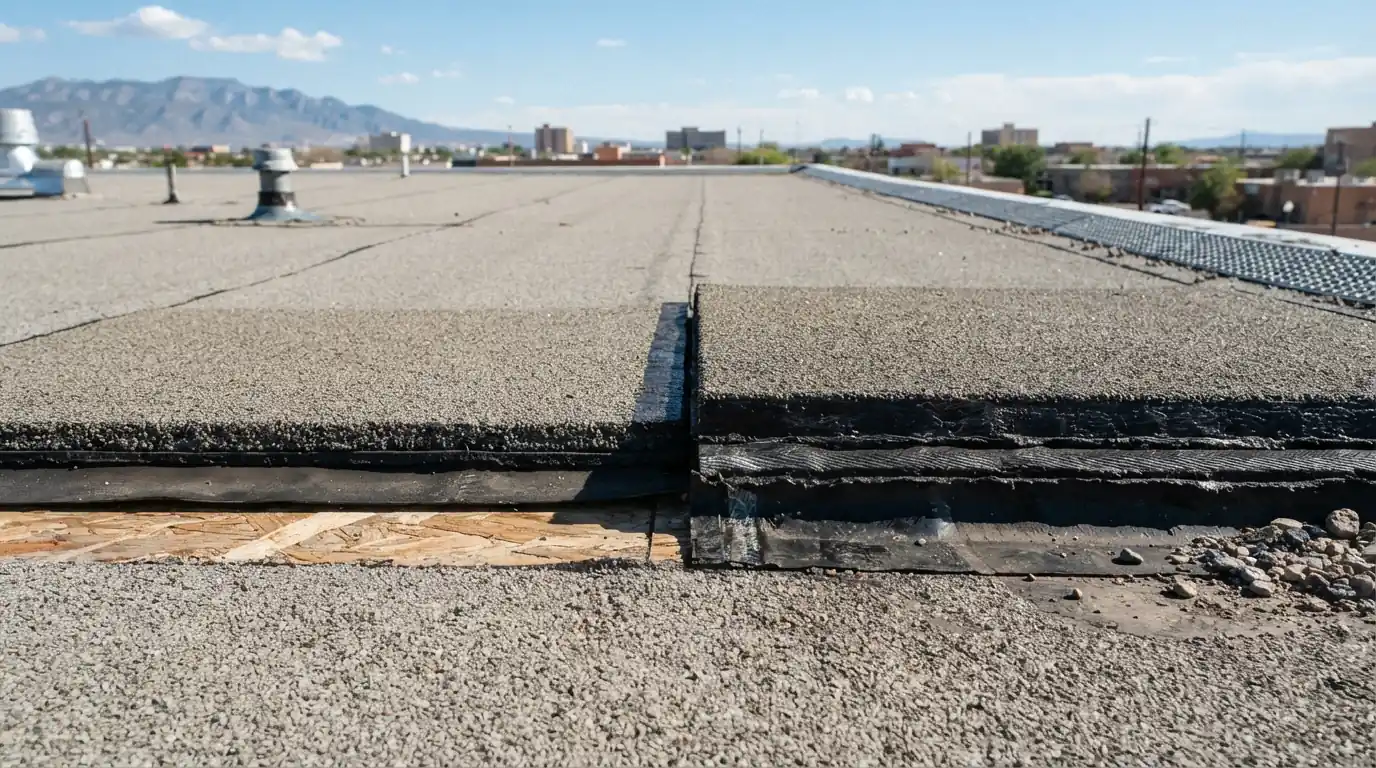
Mod-bit usually fails at laps that were never fully bonded, at flashings, and at blisters where trapped moisture or air pushed the sheet up in the heat. Open laps can be heated and re-bonded or stripped in with new material. A blister is cut open, dried, re-adhered and covered with a patch of matching sheet. Widespread blistering usually means moisture trapped under the whole roof, which points to a full replacement rather than cutting and patching new blisters every summer.
Albuquerque conditions
What this job looks like on Albuquerque roofs
Albuquerque puts roofing through daily temperature swings of 30 to 40 degrees, and asphalt membranes move with every one of them. That movement shows up first at the laps and at flashing, so lap quality matters more here than in milder climates. Homes in this city also tend to carry swamp coolers, skylights and satellite mounts on the roof, each a penetration that mod-bit has to be detailed around, and each a reason someone walks up there. That foot traffic is exactly where mod-bit earns its place.
How the job runs
How a mod-bit roof is built
- 1
Core and measure
Layer count and moisture checked; the roof measured.
- 2
Tear off and repair
Old roofing out, deck repaired, wet insulation replaced.
- 3
Base sheet
Fastened or self-adhered base ply goes down.
- 4
Interply and cap
Further plies torched or adhered, laps offset and sealed.
- 5
Flash the details
Parapets, curbs, canales and pipes stripped in.
- 6
Finish and fire watch
Cap surface finished, then a fire watch after torching ends.
FAQ
Modified bitumen questions
For foot traffic and repairs, often yes. For heat and reflectivity, TPO wins unless the mod-bit gets a white cap or coating.
With the right precautions, yes. Near wood, vents and eaves we use self-adhered sheets instead, and a fire watch follows the work.
It depends on plies, cap surface and upkeep. A reflective finish and regular recoating extend its life in strong sun.
Yes. A clean, sound mod-bit roof is a good base for an acrylic or silicone coating.
Moisture or air trapped under the sheet expands in the heat and pushes it up. Isolated blisters are repairable.
GAF, Polyglass and CertainTeed modified bitumen systems, among others. The scope names the product.