By Lawrence Reinholt, Roofing Guides Editor
Updated September 2026
Quick answer: For most Albuquerque homes with a flat roof, white TPO is the default because it reflects roughly 70 to 80 percent of the sun that hits it. Modified bitumen is the better choice where the roof takes heavy foot traffic, and spray foam suits roofs crowded with penetrations or needing more insulation. Drainage and deck condition matter more than the system.
Part 1 of 6
TPO: the reflective default
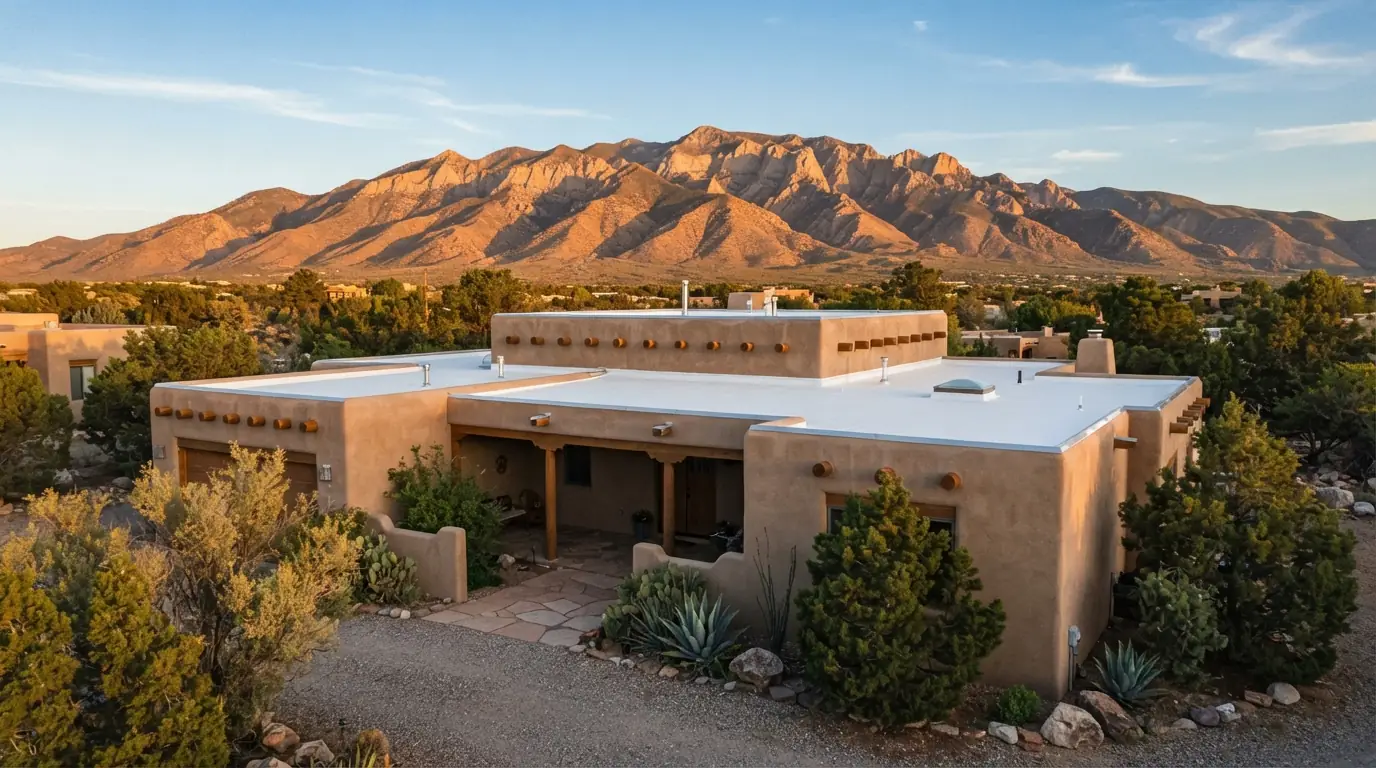
TPO is a single-ply white membrane whose seams are welded with hot air. Its big advantage here is heat: white TPO reflects most of the sun, which matters on a roof that can reach 180 degrees on a summer afternoon. Local installers report 20 to 30 years from a quality installation.
Its weak points are punctures and foot traffic, which walkway pads largely solve, and weathered TPO that needs careful preparation before patching. It is also only as good as its welds, so seam quality is the thing to ask about. Our TPO roofing page covers membrane thickness and attachment options.
Part 2 of 6
Modified bitumen: the tough one
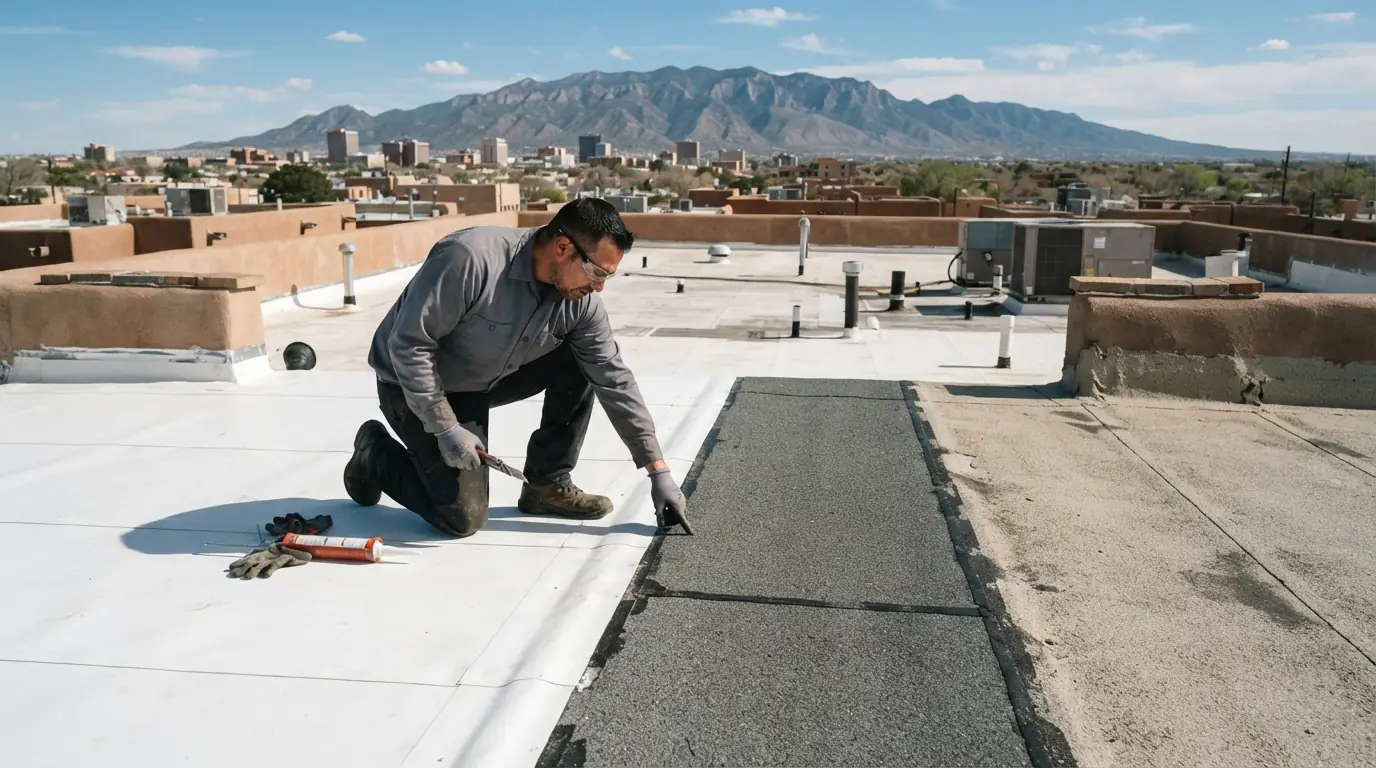
Modified bitumen is reinforced asphalt, installed in two or three plies by torch or as self-adhered sheets. It is thick, takes foot traffic well, resists punctures and can be patched with the same material for decades. That makes it the natural choice around swamp coolers and rooftop units that get serviced often.
Its weakness in Albuquerque is heat. A dark granulated cap runs much hotter than white TPO, so a white granule cap or a reflective coating on top is worth budgeting. See modified bitumen roofing for torch-down versus self-adhered.
Part 3 of 6
Spray foam: insulation and renewal
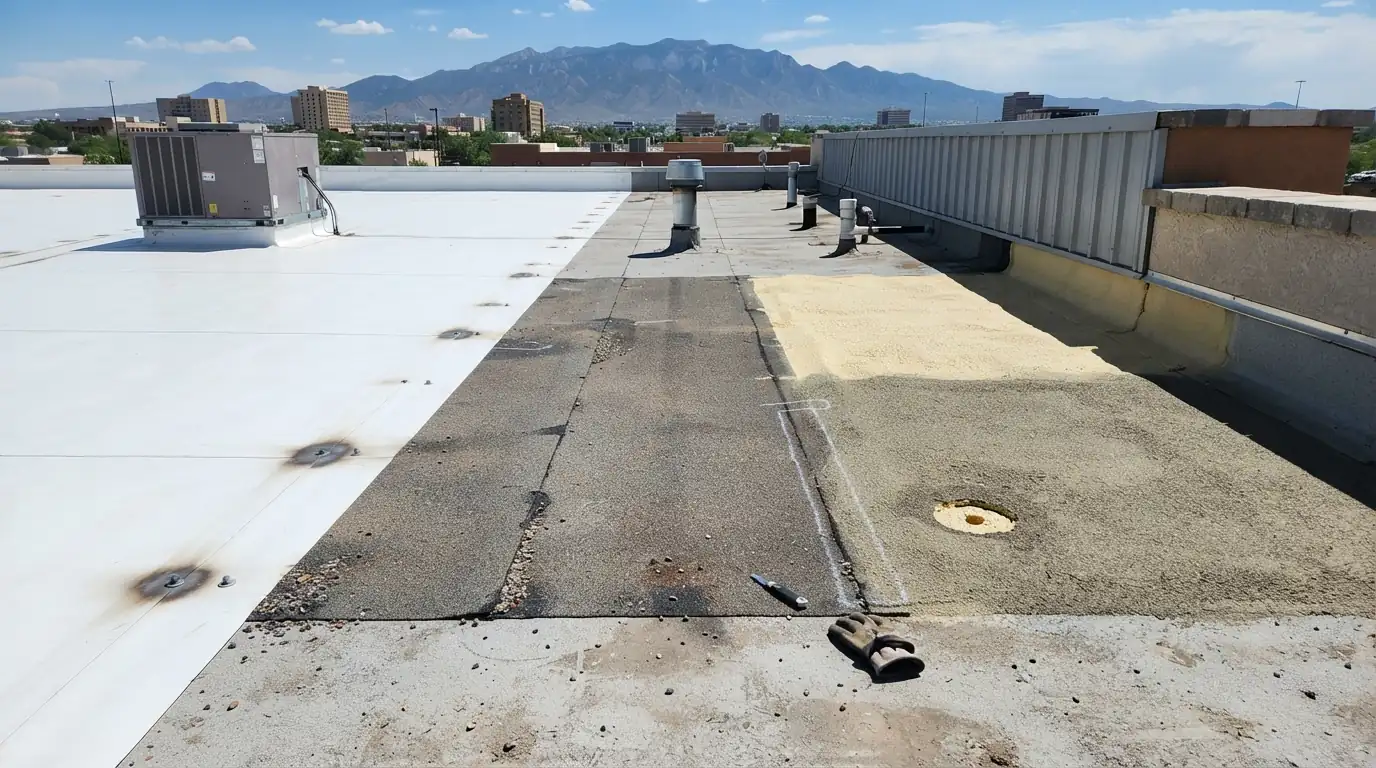
Spray foam goes on as a liquid, expands into a solid insulating layer, and is sealed with a silicone or acrylic coating. It wraps every pipe and curb without separate flashing pieces and can be built thicker in low spots to fix ponding. Kept coated, the foam itself can last for decades.
The catch is that the coating must be maintained. Exposed foam breaks down in UV, and birds and hail can puncture it. A foam roof suits an owner who will keep up a recoat schedule; our spray foam roofing page explains that cycle.
Questions about your own roof? Call and talk to a roofer.
Call (505) 636-9496Part 4 of 6
How each system handles Albuquerque weather
Sun is the constant. At about 5,300 feet the UV is stronger than at sea level, so reflective surfaces pay off: white TPO and white-coated foam stay far cooler than dark mod-bit. Temperature swings of 30 to 40 degrees a day stress seams and flashing on every system, which is why detailing matters as much as the material.
Hail and wind come with the monsoon. Mod-bit resists hail punctures best; foam coatings are the most vulnerable; TPO sits between them. Ponding is the enemy of all three, so a replacement that does not correct drainage wastes part of the money whatever system is chosen.
Your options
Side by side for this climate
| Factor | TPO | Modified bitumen | Spray foam |
|---|---|---|---|
| Summer surface heat | Low; white and reflective | High unless given a white cap | Low under a white coating |
| Foot traffic | Good with walkway pads | Very good | Fair; coating needs care |
| Hail resistance | Moderate | Best of the three | Coating can puncture |
| Upkeep | Seam and flashing checks | Seam checks, recoat if coated | Regular recoating |
Part 5 of 6
What the published prices say
Local 2026 data puts TPO at $4.00 to $6.00 per sq ft installed including removal of the old roof, modified bitumen at $3.50 to $5, and torch-down at $7 to $9. We did not find a reliable published local figure for spray foam, so we do not quote one here; foam is priced by area, thickness and the state of the existing roof.
These are planning ranges, not quotes. For more on what moves the number, see what a flat roof replacement costs.
Part 6 of 6
Choosing for your roof
Start with what the roof has to do. A simple residential flat roof with little traffic usually points to TPO. A roof with a busy swamp cooler or HVAC unit points to mod-bit, or TPO with walkway pads. A roof crowded with penetrations, or one where extra insulation is worth paying for, points to foam, provided you will keep it coated.
Then let the deck and drainage decide the details. The best system on a ponding roof still fails early, so the tapered insulation plan deserves as much attention as the membrane.
FAQ
Flat roof system questions
TPO has become the most common flat system here over the past fifteen years, largely because of its reflectivity.
Multi-ply modified bitumen resists punctures best. Foam coatings are the most vulnerable.
Yes, with a white granule cap sheet or a reflective coating.
Yes. The coating must be renewed on a schedule, or UV damages the foam underneath.
It is, with walkway pads along service routes.
Yes. A replacement is the time to choose the system that suits the roof now.
Drainage and deck condition. Ponding shortens the life of every system.