
By Lawrence Reinholt, Roofing Guides Editor
Updated September 2026
Quick answer: Flat roofs in Albuquerque leak at canales and scuppers because each outlet is a hole through the parapet where metal, membrane and stucco meet, all moving differently in the heat. Monsoon bursts push a lot of water through them in minutes, so a small gap or a partial blockage becomes a wet wall. The fix is reflashing the outlet into the roof and sizing it for the storm.
Part 1 of 6
Where the water goes on a flat roof
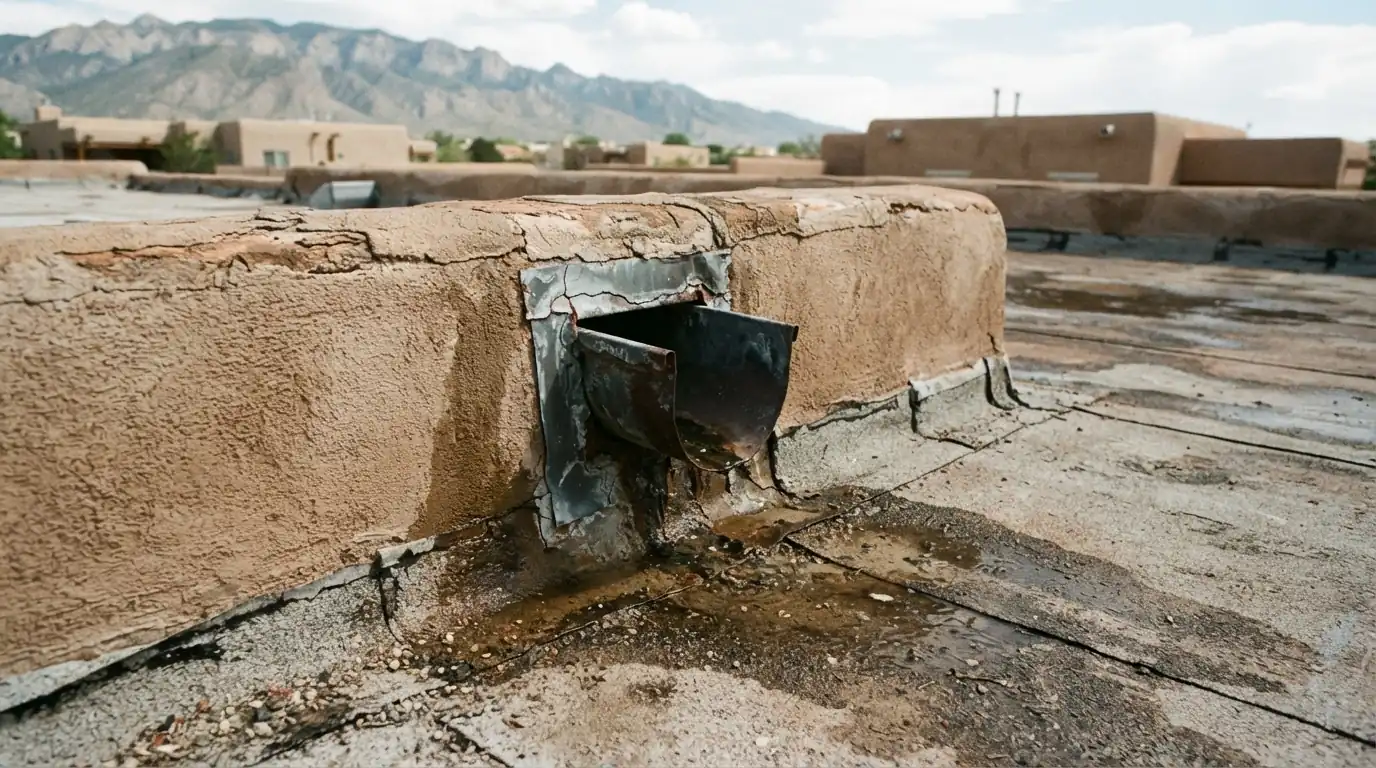
A flat roof is never truly flat; it is sloped slightly toward a few exits. On Pueblo Revival and Territorial homes those exits are usually canales, the channels that carry water through the parapet and throw it clear of the wall. Other roofs use scupper boxes feeding downspouts, or internal drains on larger roofs.
Every one of those outlets is a joint between different materials, cut through the wall that is supposed to keep water out. That is why they fail first.
Part 2 of 6
Why the joint fails
Metal, membrane and stucco expand at different rates, and Albuquerque puts them through daily temperature swings of 30 to 40 degrees. The sealant and membrane tie-in at the outlet take that movement every day. Over a few summers the sealant cracks, the membrane pulls back, or the canale sags and tips water back toward the wall.
Once the joint is open, water runs into the parapet rather than out of it, and the leak shows up as a stained wall or a wet ceiling along the edge of the room.
Part 3 of 6
What a monsoon burst does to an outlet
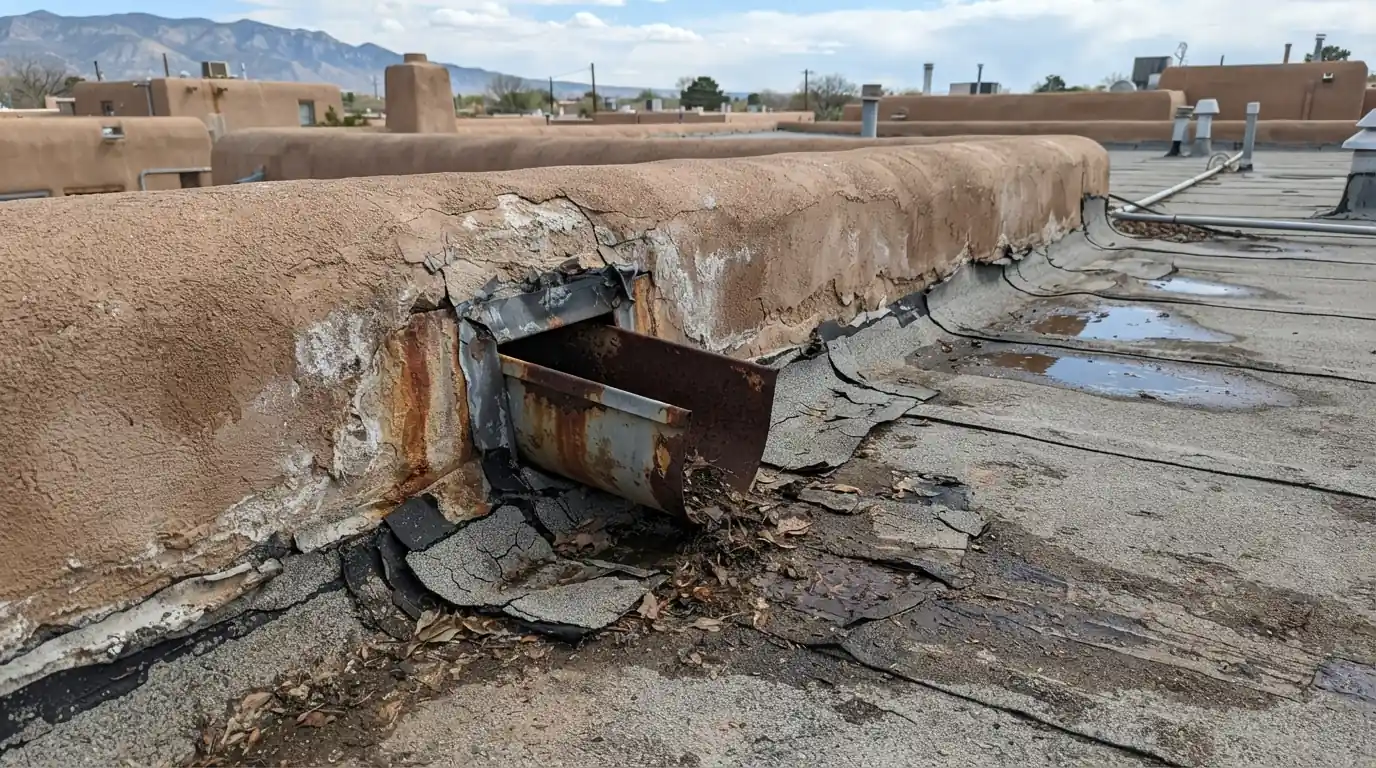
Monsoon rain arrives in short, heavy bursts. On September 28, 2025, a weather station in Kirtland AFB housing recorded more than two inches in a single hour. An outlet sized for ordinary rain overflows in a burst like that, water backs up over the flashing, and any weakness gets tested at once.
Partial blockages make it worse. Leaves, dust and nesting debris collect exactly where the water has to leave, and a canale that is half full drains at half speed. Our pre-monsoon checklist puts clearing outlets at the top for this reason.
Questions about your own roof? Call and talk to a roofer.
Call (505) 636-9496Part 4 of 6
Ponding around the outlet
When the roof is not sloped properly toward an outlet, or the outlet sits higher than the roof around it, water pools beside it for days. That standing water ages the membrane and eventually finds a seam. A small tapered cricket or sump that funnels water into the outlet usually fixes it.
Part 5 of 6
How the outlet is fixed properly
The lasting repair is to clear the outlet, remove failed sealant and membrane, reset or replace the canale or scupper with the right fall, and turn the roof membrane properly into the opening. Rusted or undersized metal is replaced with a galvanized or copper outlet sized for the roof area it drains.
Caulk over the joint is not a repair; it traps water behind it. For the full service, see canale, scupper and drain repair, and for the wall around it, parapet repair.
Part 6 of 6
Keeping outlets working
Clear outlets before the monsoon and after big wind events, check the stucco beneath them for new streaks, and have the flashing looked at during any roof visit. If leaks at the outlets are one of many problems on an old roof, see signs a tar and gravel roof is done.
FAQ
Canale and scupper questions
A gap above the normal water line, or an outlet too small for a downpour, only gets tested in a burst.
Only briefly. It traps water behind it and hides the entry point.
Galvanized costs less; copper lasts longer and weathers to a patina.
Before the monsoon and after major wind events, more often near trees.
Yes, where the roof drains toward that side.
Water is dripping back along the wall, often from a sagging canale or a failed joint.
They clog more easily and need their strainers and clamping rings checked.