By Lawrence Reinholt, Roofing Guides Editor
Updated September 2026
Quick answer: A tar and gravel roof in Albuquerque is usually done when the felt shows through bare patches of migrated gravel, blisters and soft spots spread across the field, and leaks keep appearing in new places. At that point patches only move the leak. A core sample showing wet insulation confirms it, and replacement becomes the cheaper path.
Part 1 of 6
How tar and gravel roofs work, and fail
A tar and gravel roof is a built-up roof: several layers of felt bonded with hot asphalt, with gravel embedded in the top coat. The gravel shields the asphalt from the sun. Once the gravel moves away, UV dries and cracks the exposed asphalt, and the felt beneath starts to fail.
Tar and gravel has long been the most common covering on New Mexico flat roofs, so many of the roofs still in service are old. They rarely fail all at once; they fail in more and more places until patching can no longer keep up.
Part 2 of 6
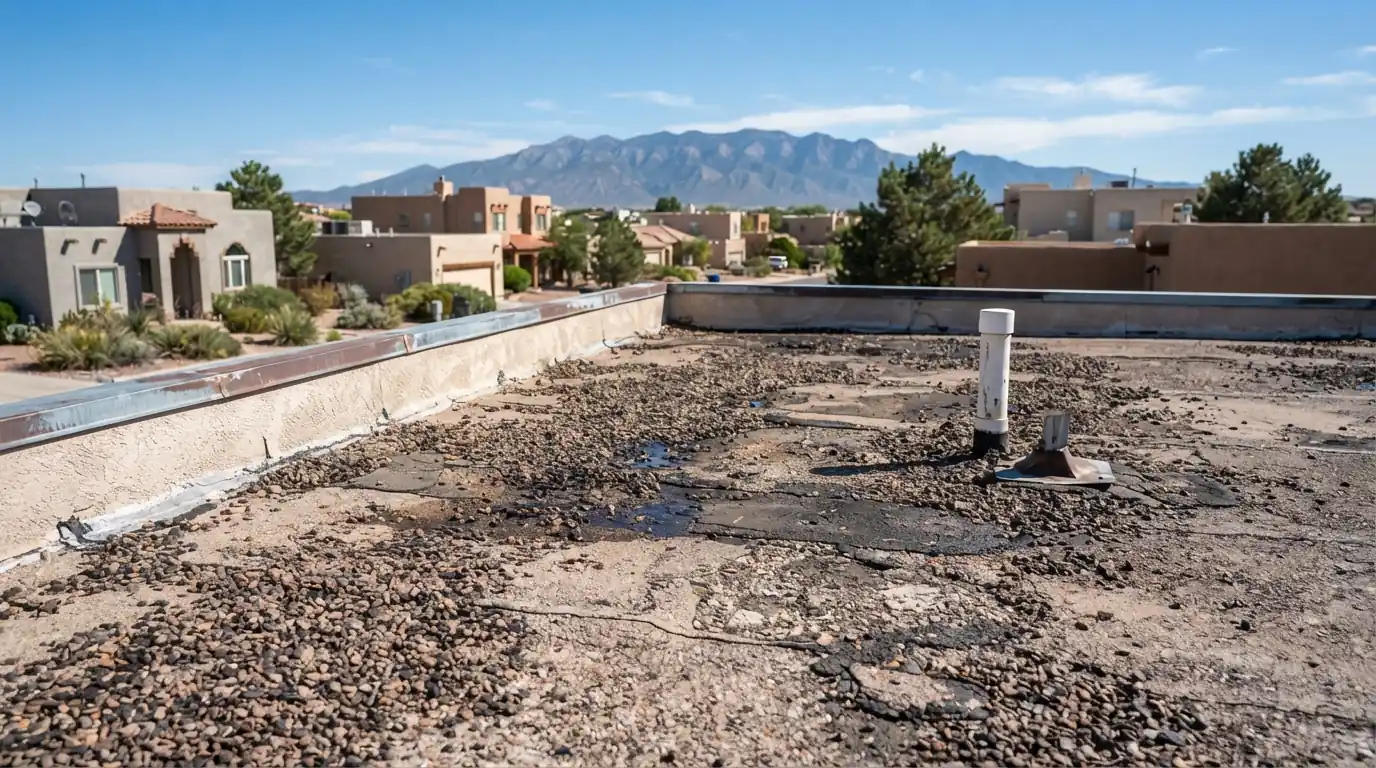
Sign one: bare felt and migrated gravel
Wind, rain and foot traffic push gravel into drifts, leaving bare patches where the black asphalt or even the felt shows. Those bare spots age quickly in strong sun. A few can be re-graveled during a repair; large areas mean the surface has lost its protection.
Part 3 of 6
Sign two: blisters and soft spots
Blisters form when trapped moisture or air expands in the heat and lifts the layers apart. Soft or spongy spots underfoot usually mean wet insulation below. One or two can be cut and repaired. When they are spread across the roof, moisture is trapped over a wide area.
This is where a core sample helps. A small cut through the roof shows whether the insulation is wet and how many layers are present, which settles the repair-or-replace question with evidence instead of guesswork.
Questions about your own roof? Call and talk to a roofer.
Call (505) 636-9496Part 4 of 6
Sign three: leaks that keep moving
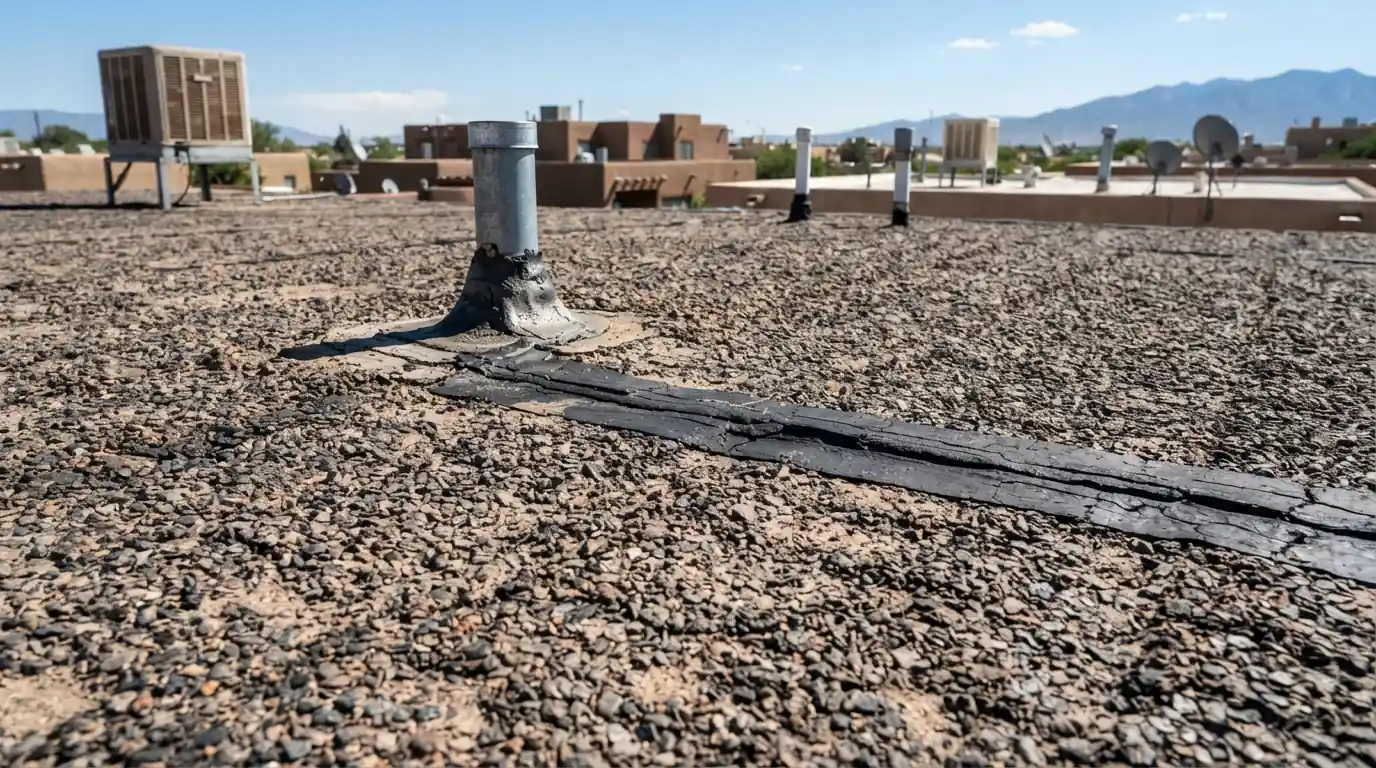
A roof that leaks in one spot has a problem. A roof that leaks in a new spot after every monsoon has a system failure. Water often travels under the layers before it drips, so a stain can be far from the opening, and old roofs tend to have many openings.
If the patches on your roof now cover a large share of the surface, the money spent on the next patch is better put toward a new roof. See flat roof repair for what a sound repair involves.
Part 5 of 6
Sign four: trouble at the edges
Old built-up roofs often hide failed flashing under layers of patches at parapets, canales and curbs. Stains down the stucco under a canale, cracks where the roof meets the parapet, or water inside exterior walls point to edge failures. Our guide on how roof outlets fail explains the details.
Part 6 of 6
What replaces tar and gravel
Most tar and gravel roofs here are replaced with TPO, modified bitumen or spray foam after a full tear-off. The tear-off is heavy and slow, and whatever wet insulation is found comes out. It is also the chance to add tapered insulation so the new roof drains.
For the choice between systems, see TPO, mod-bit or spray foam, and for what the work involves, flat roof replacement.
FAQ
Tar and gravel roof questions
Yes, by scraping back the gravel, rebuilding the layers and re-embedding gravel. It works on a mostly sound roof.
Rarely well. The gravel makes a poor base for coatings.
It is heavy, often more than one layer deep, and slow to remove and haul.
Usually. A core sample confirms it.
TPO, for its reflectivity, with mod-bit and foam chosen for specific roof needs.
If the roof is clearly done, spring is ideal. Otherwise, a repair to get through summer and a fall replacement works.
Once two layers exist, the building code requires both to come off at the next replacement.